

-
1 method dictionary
словарь методов [класса]структура данных, содержащая таблицу процедур, определённых для данного класса. Эти процедуры, называемые методами, представляют допустимые операции, которые могут инициироваться сообщениями (сообщение содержит индекс метода), получаемыми экземплярами классаАнгло-русский толковый словарь терминов и сокращений по ВТ, Интернету и программированию. > method dictionary
-
2 method
1) методв ООП - операция, выполняемая объектом; именованная встроенная процедура или функция, ассоциированная с объектом, которая изменяет состояние объекта или заставляет его отправить сообщение, т. е. реализует поведение объекта (instance behavior) данного класса. Метод может иметь параметры. Существуют также методы класса (class method). Термин был впервые введён в языке SmallTalk. Большинство объектов имеют три типа методов: конструкторы (см. constructor), деструкторы (см. destructor) и методы поведения (см. behavior). Методы также делятся на закрытые (private method) и открытые (public).Syn:см. тж. abstract method, final method, instance method, member method, message, method declaration, method dictionary, method name, method override, object, OOP, private method, procedure2) правилоот греч. methodos - исследованиесм. тж. finished method3) способ, приёмсм. тж. debug methodАнгло-русский толковый словарь терминов и сокращений по ВТ, Интернету и программированию. > method
-
3 base stock method
базовый метод оценки стоимости запасов
Метод учета стоимости запасов, предполагающий, что определенная часть запасов никогда не движется и, следовательно, сохраняет свою первоначальную стоимость (см.: average stock (средний запас); first in, first out (метод оценки и учета запасов в порядке их поступления); last in, first out (метод оценки и учета запасов в обратном порядке)).
[ http://www.vocable.ru/dictionary/533/symbol/97]Тематики
EN
Англо-русский словарь нормативно-технической терминологии > base stock method
-
4 use
1.[ju:s] noun1) Gebrauch, der; (of dictionary, calculator, room) Benutzung, die; (of word, expression; of pesticide, garlic, herb, spice) Verwendung, die; (of name, title) Führung, die; (of alcohol, drugs) Konsum, derthe use of brutal means/methods — die Anwendung brutaler Mittel/Methoden
the use of troops/teargas/violence — der Einsatz von Truppen/Tränengas/die Gewaltanwendung
constant/rough use — dauernder Gebrauch/schlechte Behandlung
[not] be in use — [nicht] in Gebrauch sein
be no longer in use — nicht mehr verwendet werden
be in daily etc. use — täglich usw. in Gebrauch od. Benutzung sein
go/fall out of use — außer Gebrauch kommen
instructions/directions for use — Gebrauchsanweisung, die
ready for [immediate] use — [sofort] gebrauchsfertig
batteries for use in or with watches — Batterien [speziell] für Armbanduhren
a course for use in schools — ein Kurs für die Schule od. zur Verwendung im Schulunterricht
for personal/private use — für den persönlichen Gebrauch/den Privatgebrauch
for external use only — nur zur äußerlichen Anwendung
for use in an emergency/only in case of fire — für den Notfall/nur bei Feuer zu benutzen
with careful etc. use — bei sorgsamer usw. Behandlung
make use of somebody/something — jemanden/etwas gebrauchen/(exploit) ausnutzen
make the best use of something/it — das Beste aus etwas/daraus machen
make good use of, turn or put to good use — gut nutzen [Zeit, Talent, Geld]
2) (utility, usefulness) Nutzen, derthese tools/clothes will be of use to somebody — dieses Werkzeug wird/diese Kleider werden für jemanden von Nutzen sein
is it of [any] use? — ist das [irgendwie] zu gebrauchen od. von Nutzen?
can I be of any use to you? — kann ich dir irgendwie helfen?
be [of] no use [to somebody] — [jemandem] nichts nützen
he is [of] no use in a crisis/as a manager — er ist in einer Krise/als Manager zu nichts nütze od. (ugs.) nicht zu gebrauchen
it's no use [doing that] — es hat keinen Zweck od. Sinn[, das zu tun]
you're/that's a fat lot of use — (coll. iron.) du bist ja eine schöne Hilfe/davon haben wir aber was (ugs. iron.)
what's the use of that/of doing that? — was nützt das/was nützt es, das zu tun?
oh well, what's the use! — ach, was soll's schon! (ugs.)
have its/one's uses — seinen Nutzen haben
have/find a use for something/somebody — für etwas/jemanden Verwendung haben/finden
have no/not much use for something/somebody — etwas/jemanden nicht/kaum brauchen
put something to a good/a new use — etwas sinnvoll/auf neu[artig]e Weise verwenden
4) (right or power of using)[have the] use of kitchen and bathroom — Küchen- und Badbenutzung [haben]
2.let somebody have or give somebody the use of something — jemanden etwas benutzen lassen
[ju:z] transitive verb1) benutzen; nutzen [Gelegenheit]; anwenden [Gewalt]; einsetzen [Tränengas, Wasserwerfer]; in Anspruch nehmen [Firma, Agentur, Agenten, Dienstleistung]; nutzen [Zeit, Gelegenheit, Talent, Erfahrung]; führen [Namen, Titel]do you know how to use this tool? — kannst du mit diesem Werkzeug umgehen?
anything you say may be used in evidence — was Sie sagen, kann vor Gericht verwendet werden
use somebody's name [as a reference] — sich [als Empfehlung] auf jemanden berufen
I could use the money/a drink — (coll.) ich könnte das Geld brauchen/einen Drink vertragen (ugs.)
use one's time to do something — seine Zeit dazu nutzen, etwas zu tun
2) (consume as material) verwendenuse gas/oil for heating — mit Gas/Öl heizen
the camera uses 35 mm film — für die Kamera braucht man einen 35-mm-Film
‘use sparingly’ — "sparsam verwenden!"
3) (take habitually)use drugs/heroin — etc. Drogen/Heroin usw. nehmen
4) (employ in speaking or writing) benutzen; gebrauchen; verwendenuse diplomacy/tact [in one's dealings etc. with somebody] — [bei jemandem] diplomatisch vorgehen/[zu jemandem] taktvoll sein
use a method/tactics — eine Methode anwenden/nach einer [bestimmten] Taktik vorgehen
6) (take advantage of)7) (treat) behandelnuse somebody/something well/badly — jemanden/etwas gut/schlecht behandeln
8)I used to live in London/work in a factory — früher habe ich in London gelebt/in einer Fabrik gearbeitet
he used to be very shy — er war früher sehr schüchtern
my mother always used to say... — meine Mutter hat immer gesagt od. pflegte zu sagen...
this used to be my room — das war [früher] mein Zimmer
things aren't what they used to be — es ist nichts mehr so wie früher
I used not or I did not use — or (coll.)
I didn't use or (coll.) I use[d]n't to smoke — früher habe ich nicht geraucht
Phrasal Verbs:- academic.ru/93389/use_up">use up* * *I [ju:z] verb1) (to employ (something) for a purpose: What did you use to open the can?; Use your common sense!) benutzen2) (to consume: We're using far too much electricity.) verbrauchen•- usable- used
- user
- user-friendly
- user guide
- be used to something
- be used to
- used to II [ju:s]1) (the act of using or state of being used: The use of force to persuade workers to join a strike cannot be justified; This telephone number is for use in emergencies.) der Gebrauch2) (the/a purpose for which something may be used: This little knife has plenty of uses; I have no further use for these clothes.) die Verwendbarkeit3) ((often in questions or with negatives) value or advantage: Is this coat (of) any use to you?; It's no use offering to help when it's too late.) der Nutzen4) (the power of using: She lost the use of her right arm as a result of the accident.) die Fähigkeit(etwas)zu gebrauchen5) (permission, or the right, to use: They let us have the use of their car while they were away.) das Benutzungsrecht•- useful- usefulness
- usefully
- useless
- be in use
- out of use
- come in useful
- have no use for
- it's no use
- make good use of
- make use of
- put to good use
- put to use* * *I. vt[ju:z]1. (make use of, utilize)▪ to \use sth etw benutzen; building, one's skills, training, talent etw nutzen; method etw anwendenthis glass has been \used dieses Glas ist schon benutztI could \use some help ich könnte etwas Hilfe gebrauchenI could \use a drink now ich könnte jetzt einen Drink vertragen famthis table could \use a wipe diesen Tisch könnte man auch mal wieder abwischenthese lights are \used for illuminating the playing area mit diesen Lichtern wird die Spielfläche beleuchtetwhat perfume do you \use? welches Parfüm nimmst du?what shampoo do you \use? welches Shampoo benutzt du?I've got to \use the toilet ich muss auf die Toiletteto \use alcohol Alkohol trinkento \use one's brains seinen Verstand benutzento \use a chance eine Gelegenheit nutzento \use a dictionary ein Wörterbuch verwendento \use drugs Drogen nehmento \use military force against sb Militärgewalt gegen jdn einsetzento \use an idea eine Idee verwendento \use logic logisch denkento \use one's money to do sth sein Geld dazu verwenden, etw zu tunshe \uses the name Mary Punk sie nennt sich Mary Punkto \use poison gas/truncheons/chemical warfare Giftgas/Schlagstöcke/chemische Waffen einsetzento \use a pseudonym ein Pseudonym benutzento \use service eine Dienstleistung in Anspruch nehmento \use swear words fluchento \use one's time to do sth seine Zeit dazu nutzen, etw zu tunyou should \use your free time more constructively du solltest deine freie Zeit sinnvoller nutzen!to \use violence Gewalt anwenden▪ to \use sth to do sth etw benutzen [o verwenden], um etw zu tun\use scissors to cut the shapes out schneiden Sie die Formen mit einer Schere ausyou can \use this brush to apply the paint du kannst die Farbe mit diesem Pinsel auftragen2. (employ)▪ to \use sth:\use your imagination! lass doch mal deine Fantasie spielen!to \use common sense seinen gesunden Menschenverstand benutzento \use discretion/tact diskret/taktvoll sein3. (get through, consume)▪ to \use sth etw verbrauchenwe've \used nearly all the bread wir haben fast kein Brot mehrwhat do you \use for heating? womit heizen Sie?there's no more paper after this is \used wenn wir dieses Papier aufgebraucht haben, ist keines mehr dathis radio \uses 1.5 volt batteries für dieses Radio braucht man 1,5 Volt Batteriento \use energy Energie verbrauchen▪ to \use sb/sth jdn/etw ausnutzento \use sb badly/well jdn schlecht/gut behandelnhe's \used her despicably er hat ihr übel mitgespieltII. n[ju:s]1. (application, employment) Verwendung f ( for für + akk); of dictionary also Benutzung f; of labour Einsatz m; of leftovers Verwertung f; of talent, experience Nutzung mdon't throw that away, you'll find a \use for it one day wirf das nicht weg — eines Tages wirst du es schon noch irgendwie verwenden könnena food processor has a variety of \uses in the kitchen eine Küchenmaschine kann man auf ganz unterschiedliche Weise in der Küche einsetzenthey've called for further restrictions on the \use of leaded petrol sie forderten weitere Einschränkungen für die Verwendung von verbleitem Benzinshe lost the \use of her fingers in the accident seit dem Unfall kann sie ihre Finger nicht mehr benutzenthe \use of alcohol/drugs der Alkohol-/Drogenkonsumby the \use of deception durch Täuschungdirections for \use Gebrauchsanweisung ffor \use in an emergency für den Notfallfor \use in case of fire bei Feuerthe \use of force/a particular method die Anwendung von Gewalt/einer bestimmten Methodethe correct \use of language der korrekte Sprachgebrauchthe \use of poison gas/truncheons/chemical warfare der Einsatz von Tränengas/Schlagstöcken/chemischen Waffento be in daily \use täglich verwendet werdenfor external \use only nur zur äußerlichen Anwendungto be no longer in \use nicht mehr benutzt werdenready for \use gebrauchsfertig; machine einsatzbereitfor private \use only nur für den Privatgebrauchto come into \use in Gebrauch kommento find a \use for sth für etw akk Verwendung findento have no [further] \use for sth keine Verwendung [mehr] für etw akk habendo you have any \use for these old notes? kannst du diese alten Unterlagen irgendwie verwenden?to make \use of sth etw benutzen [o ÖSTERR a. benützen]; experience, talent etw nutzen; leftovers etw verwenden; connections von etw dat Gebrauch machencan you make \use of that? kannst du das gebrauchen?to put sth to \use etw verwendento be able to put sth to good \use etw gut verwenden könnento be able to put one's experience to good \use seine Erfahrung gut einbringen könnenin/out of \use in/außer Gebrauchbuilding a dam would be a \use of financial resources which this country cannot afford für einen Dammbau würde dieses Land Gelder verwenden müssen, die es nicht aufbringen kanncan I be of any \use? kann ich vielleicht irgendwie behilflich sein?what's the \use of shouting? was bringt es denn herumzuschreien?there's no \use complaining Herumjammern bringt auch nichts famwhat \use is praying? wozu soll das Beten nutzen?it has its \uses das kann auch nützlich seinhe's no \use as an editor als Redakteur ist er nicht zu gebrauchenthat's a fat lot of \use da haben wir ja auch was von! iron famto be no \use keine Hilfe seinto be no/not much \use to sb jdm nichts/nicht viel nützen▪ to be of \use to sb für jdn von Nutzen [o nützlich] seinis this of any \use to you? kannst du das vielleicht gebrauchen?▪ it's no \use [doing sth] es hat keinen Zweck[, etw zu tun]it's no \use — I just can't stand the man es hilft alles nichts — ich kann den Mann einfach nicht ausstehen!it's no \use trying to escape — no one has ever got away before wir brauchen erst gar nicht versuchen auszubrechen — das hat bisher noch keiner geschafft!4. (right)to give sb [or let sb have] the \use of sth jdn etw benutzen [o ÖSTERR a. benützen] lassen6. (out of order)the escalator is out of \use der Aufzug ist außer Betrieb* * *I [juːz]1. vt1) (= utilize) benutzen; dictionary, means, tools, object, materials verwenden, benutzen; sb's suggestion, idea verwenden; word, literary style gebrauchen, verwenden, benutzen; swear words gebrauchen, benutzen; brains, intelligence gebrauchen; method, system, technique, therapy, force, trickery anwenden; one's abilities, powers of persuasion, one's strength aufwenden, anwenden; tact, care walten lassen; drugs einnehmenuse only in emergencies — nur im Notfall gebrauchen or benutzen
I have to use the toilet before I go —
to use sth for sth —
he used it as a spoon the police used truncheons — er hat es als Löffel benutzt or verwendet die Polizei setzte Schlagstöcke ein, die Polizei benutzte or gebrauchte Schlagstöcke
the money is to be used to set up a trust —
what sort of fuel do you use? — welchen Treibstoff verwenden Sie?, mit welchem Treibstoff fahren Sie?
why don't you use a hammer? — warum nehmen Sie nicht einen Hammer dazu?, warum benutzen or verwenden Sie nicht einen Hammer dazu?
to use sb's name — jds Namen verwenden or benutzen; (as reference) jds Namen angeben, sich auf jdn berufen
2) (= make use of, exploit) information, one's training, talents, resources, chances, opportunity (aus)nutzen, (aus)nützen (S Ger); advantage nutzen; waste products nutzen, verwertenyou can use the leftovers to make a soup —
you should use your free time for something creative — Sie sollten Ihre Freizeit für etwas Schöpferisches nutzen or gebrauchen
3) (inf)have you used all the ink? — haben Sie die Tinte aufgebraucht (inf) or die ganze Tinte verbraucht?
how has the world been using you? (not obs, liter) — wie gehts, wie stehts?
6) (pej: exploit) ausnutzenI feel ( I've just been) used — ich habe das Gefühl, man hat mich ausgenutzt; (sexually) ich komme mir missbraucht vor
2. n[juːs]1) (= employment) Verwendung f; (of materials, tools, means, dictionary) Benutzung f, Verwendung f; (= operation of machines etc) Benutzung f; (= working with of dictionary, calculator etc) Gebrauch m; (of word, style) Gebrauch m, Verwendung f; (of swearwords, arms, intelligence) Gebrauch m; (of method, system, technique, force, powers of persuasion) Anwendung f; (of personnel, truncheons etc) Verwendung f, Einsatz m; (of drugs) Einnahme fonce you've mastered the use of the clutch — wenn Sie erst einmal den Gebrauch der Kupplung beherrschen
the use of a calculator to solve... — die Verwendung eines Rechners, um... zu lösen
for external use —
ready for use — gebrauchsfertig; machine einsatzbereit
to make use of sth — von etw Gebrauch machen, etw benutzen
in use/out of use — in or im/außer Gebrauch; machines also in/außer Betrieb
to be in daily use/no longer in use — täglich/nicht mehr benutzt or verwendet or gebraucht werden
to make good/bad use of sth — etw gut/schlecht nutzen
3) (= way of using) Verwendung fto learn the use of sth — lernen, wie etw verwendet or benutzt or gebraucht wird
to have no use for (lit, fig) — nicht gebrauchen können, keine Verwendung haben für
to have no further use for sb/sth — keine Verwendung mehr haben für jdn/etw, jdn/etw nicht mehr brauchen
4) (= usefulness) Nutzen mthis is no use any more — das taugt nichts mehr, das ist zu nichts mehr zu gebrauchen
is this (of) any use to you? — können Sie das brauchen?, können Sie damit was anfangen?
he/it has his/its uses — er/das ist ganz nützlich
you're no use to me if you can't spell — du nützt mir nichts, wenn du keine Rechtschreibung kannst
he's no use as a goalkeeper — er taugt nicht als Torhüter, er ist als Torhüter nicht zu gebrauchen
a (fat) lot of use that will be to you! (iro inf) — da hast du aber was davon
this is no use, we must start work — so hat das keinen Zweck or Sinn, wir müssen etwas tun
it's no use you or your protesting — es hat keinen Sinn or es nützt nichts, wenn du protestierst
what's the use of telling him? — was nützt es, wenn man es ihm sagt?
what's the use in trying/going? — wozu überhaupt versuchen/gehen?
ah, what's the use! — ach, was solls!
5) (= right) Nutznießung f (JUR)to give sb the use of sth — jdn etw benutzen lassen; of car also, of money jdm etw zur Verfügung stellen
to have the full use of one's faculties — im Vollbesitz seiner (geistigen und körperlichen) Kräfte sein
6) (= custom) Brauch m, Usus m (geh)II [juːs]vb auxSee:→ used* * *use [juːz]A v/t1. gebrauchen, benutzen, an-, verwenden, sich (gen) bedienen, Gebrauch machen von, eine Gelegenheit etc nutzen oder sich zunutze machen:use one’s brains den Verstand gebrauchen, seinen Kopf anstrengen;use care Sorgfalt verwenden;use force Gewalt anwenden;use one’s legs zu Fuß gehen;may I use your name? darf ich mich auf Sie berufen?;use a right von einem Recht Gebrauch machen;anything you say may be used against you JUR alles, was Sie sagen, kann gegen Sie verwendet werden2. ein Gerät etc handhaben3. verwenden (on auf akk)4. use upa) auf-, verbrauchen, jemandes Kraft erschöpfen,b) umg jemanden fertigmachen, erschöpfen: → used1 25. a) besonders US gewohnheitsmäßig zu sich nehmen:use drugs Drogen nehmen;use tobacco rauchenb) brauchen:6. behandeln, verfahren mit:use sb ill jemanden schlecht behandeln;how has the world used you? umg wie ist es dir ergangen?7. pej jemanden benutzen, auch eine Situation etc ausnutzen8. Zeit verbringenit used to be said that … man pflegte zu sagen, dass …;he does not come as often as he used to er kommt nicht mehr so oft wie früher oder sonst;he used to be a polite man er war früher oder sonst (immer) sehr höflich;he used to live here er wohnte früher hier;she used to astonish me with … sie überraschte mich immer wieder mit …;I used to smoke ich hab früher oder einmal geraucht;did you really use to smoke? hast du früher wirklich geraucht?C s [juːs]1. Gebrauch m, Benutzung f, An-, Verwendung f:for use zum Gebrauch;for use in schools für den Schulgebrauch;in use in Gebrauch, gebräuchlich;be in daily use täglich gebraucht werden;be in common use allgemein gebräuchlich sein;come into use in Gebrauch kommen;out of use nicht in Gebrauch, nicht mehr gebräuchlich;with use durch (ständigen) Gebrauch;make use of Gebrauch machen von, benutzen;make use of sb’s name sich auf jemanden berufen;make (a) bad use of (einen) schlechten Gebrauch machen von;make full use of sth etwas voll ausnützen;2. a) Verwendung(szweck) f(m)b) Brauchbarkeit f, Verwendbarkeit fc) Zweck m, Sinn m, Nutzen m, Nützlichkeit f:of no use nutz-, zwecklos, unbrauchbar, unnütz;is this of use to you? können Sie das (ge)brauchen?;crying is no use Weinen führt zu nichts;it is no ( oder it isn’t any) use talking es ist nutz- oder zwecklos zu reden, es hat keinen Zweck zu reden;what is the use of it? was hat das (überhaupt) für einen Zweck?;a) nicht brauchen können,b) mit etwas od jemandem nichts anfangen können,c) bes US umg nichts übrighaben für jemanden od etwas;put to (good) use (gut) an- oder verwenden;this tool has different uses dieses Gerät kann für verschiedene Zwecke verwendet werden; → further B 13. Kraft f oder Fähigkeit f (etwas) zu gebrauchen, Gebrauch m:he lost the use of his right eye er kann auf dem rechten Auge nichts mehr sehen;have the use of one’s limbs sich bewegen können4. Benutzungsrecht n:have the use of sth etwas benutzen können oder dürfen5. Gewohnheit f, Brauch m:once a use and ever a custom (Sprichwort) jung gewohnt, alt getan6. JURa) Nießbrauch m, Nutznießung fb) Nutzen m* * *1.[ju:s] noun1) Gebrauch, der; (of dictionary, calculator, room) Benutzung, die; (of word, expression; of pesticide, garlic, herb, spice) Verwendung, die; (of name, title) Führung, die; (of alcohol, drugs) Konsum, derthe use of brutal means/methods — die Anwendung brutaler Mittel/Methoden
the use of troops/teargas/violence — der Einsatz von Truppen/Tränengas/die Gewaltanwendung
constant/rough use — dauernder Gebrauch/schlechte Behandlung
[not] be in use — [nicht] in Gebrauch sein
be in daily etc. use — täglich usw. in Gebrauch od. Benutzung sein
go/fall out of use — außer Gebrauch kommen
instructions/directions for use — Gebrauchsanweisung, die
ready for [immediate] use — [sofort] gebrauchsfertig
batteries for use in or with watches — Batterien [speziell] für Armbanduhren
a course for use in schools — ein Kurs für die Schule od. zur Verwendung im Schulunterricht
for personal/private use — für den persönlichen Gebrauch/den Privatgebrauch
for use in an emergency/only in case of fire — für den Notfall/nur bei Feuer zu benutzen
with careful etc. use — bei sorgsamer usw. Behandlung
make use of somebody/something — jemanden/etwas gebrauchen/ (exploit) ausnutzen
make the best use of something/it — das Beste aus etwas/daraus machen
make good use of, turn or put to good use — gut nutzen [Zeit, Talent, Geld]
2) (utility, usefulness) Nutzen, derthese tools/clothes will be of use to somebody — dieses Werkzeug wird/diese Kleider werden für jemanden von Nutzen sein
is it of [any] use? — ist das [irgendwie] zu gebrauchen od. von Nutzen?
be [of] no use [to somebody] — [jemandem] nichts nützen
he is [of] no use in a crisis/as a manager — er ist in einer Krise/als Manager zu nichts nütze od. (ugs.) nicht zu gebrauchen
it's no use [doing that] — es hat keinen Zweck od. Sinn[, das zu tun]
you're/that's a fat lot of use — (coll. iron.) du bist ja eine schöne Hilfe/davon haben wir aber was (ugs. iron.)
what's the use of that/of doing that? — was nützt das/was nützt es, das zu tun?
oh well, what's the use! — ach, was soll's schon! (ugs.)
have its/one's uses — seinen Nutzen haben
have/find a use for something/somebody — für etwas/jemanden Verwendung haben/finden
have no/not much use for something/somebody — etwas/jemanden nicht/kaum brauchen
put something to a good/a new use — etwas sinnvoll/auf neu[artig]e Weise verwenden
[have the] use of kitchen and bathroom — Küchen- und Badbenutzung [haben]
2.let somebody have or give somebody the use of something — jemanden etwas benutzen lassen
[ju:z] transitive verb1) benutzen; nutzen [Gelegenheit]; anwenden [Gewalt]; einsetzen [Tränengas, Wasserwerfer]; in Anspruch nehmen [Firma, Agentur, Agenten, Dienstleistung]; nutzen [Zeit, Gelegenheit, Talent, Erfahrung]; führen [Namen, Titel]anything you say may be used in evidence — was Sie sagen, kann vor Gericht verwendet werden
use somebody's name [as a reference] — sich [als Empfehlung] auf jemanden berufen
I could use the money/a drink — (coll.) ich könnte das Geld brauchen/einen Drink vertragen (ugs.)
use one's time to do something — seine Zeit dazu nutzen, etwas zu tun
2) (consume as material) verwendenuse gas/oil for heating — mit Gas/Öl heizen
‘use sparingly’ — "sparsam verwenden!"
use drugs/heroin — etc. Drogen/Heroin usw. nehmen
4) (employ in speaking or writing) benutzen; gebrauchen; verwenden5) (exercise, apply) Gebrauch machen von [Autorität, Einfluss, Können, Menschenverstand]use diplomacy/tact [in one's dealings etc. with somebody] — [bei jemandem] diplomatisch vorgehen/[zu jemandem] taktvoll sein
use a method/tactics — eine Methode anwenden/nach einer [bestimmten] Taktik vorgehen
7) (treat) behandelnuse somebody/something well/badly — jemanden/etwas gut/schlecht behandeln
8)used to — (formerly)
I used to live in London/work in a factory — früher habe ich in London gelebt/in einer Fabrik gearbeitet
my mother always used to say... — meine Mutter hat immer gesagt od. pflegte zu sagen...
this used to be my room — das war [früher] mein Zimmer
I used not or I did not use — or (coll.)
I didn't use or (coll.) I use[d]n't to smoke — früher habe ich nicht geraucht
Phrasal Verbs:- use up* * *v.anwenden v.ausführen v.belegen v.benutzen v.gebrauchen v.nutzen v.verwenden v.wahrnehmen (Vorteil, Gelegenheit) v. n.Anwendung f.Benutzung f.Gebrauch -¨e m.Inanspruchnahme f.Nutzung -en f.Verwendung f.Verwendungszweck m. -
5 Bibliography
■ Aitchison, J. (1987). Noam Chomsky: Consensus and controversy. New York: Falmer Press.■ Anderson, J. R. (1980). Cognitive psychology and its implications. San Francisco: W. H. Freeman.■ Anderson, J. R. (1983). The architecture of cognition. Cambridge, MA: Harvard University Press.■ Anderson, J. R. (1995). Cognitive psychology and its implications (4th ed.). New York: W. H. Freeman.■ Archilochus (1971). In M. L. West (Ed.), Iambi et elegi graeci (Vol. 1). Oxford: Oxford University Press.■ Armstrong, D. M. (1990). The causal theory of the mind. In W. G. Lycan (Ed.), Mind and cognition: A reader (pp. 37-47). Cambridge, MA: Basil Blackwell. (Originally published in 1981 in The nature of mind and other essays, Ithaca, NY: University Press).■ Atkins, P. W. (1992). Creation revisited. Oxford: W. H. Freeman & Company.■ Austin, J. L. (1962). How to do things with words. Cambridge, MA: Harvard University Press.■ Bacon, F. (1878). Of the proficience and advancement of learning divine and human. In The works of Francis Bacon (Vol. 1). Cambridge, MA: Hurd & Houghton.■ Bacon, R. (1928). Opus majus (Vol. 2). R. B. Burke (Trans.). Philadelphia, PA: University of Pennsylvania Press.■ Bar-Hillel, Y. (1960). The present status of automatic translation of languages. In F. L. Alt (Ed.), Advances in computers (Vol. 1). New York: Academic Press.■ Barr, A., & E. A. Feigenbaum (Eds.) (1981). The handbook of artificial intelligence (Vol. 1). Reading, MA: Addison-Wesley.■ Barr, A., & E. A. Feigenbaum (Eds.) (1982). The handbook of artificial intelligence (Vol. 2). Los Altos, CA: William Kaufman.■ Barron, F. X. (1963). The needs for order and for disorder as motives in creative activity. In C. W. Taylor & F. X. Barron (Eds.), Scientific creativity: Its rec ognition and development (pp. 153-160). New York: Wiley.■ Bartlett, F. C. (1932). Remembering: A study in experimental and social psychology. Cambridge: Cambridge University Press.■ Bartley, S. H. (1969). Principles of perception. London: Harper & Row.■ Barzun, J. (1959). The house of intellect. New York: Harper & Row.■ Beach, F. A., D. O. Hebb, C. T. Morgan & H. W. Nissen (Eds.) (1960). The neu ropsychology of Lashley. New York: McGraw-Hill.■ Berkeley, G. (1996). Principles of human knowledge: Three Dialogues. Oxford: Oxford University Press. (Originally published in 1710.)■ Berlin, I. (1953). The hedgehog and the fox: An essay on Tolstoy's view of history. NY: Simon & Schuster.■ Bierwisch, J. (1970). Semantics. In J. Lyons (Ed.), New horizons in linguistics. Baltimore: Penguin Books.■ Black, H. C. (1951). Black's law dictionary. St. Paul, MN: West Publishing.■ Bloom, A. (1981). The linguistic shaping of thought: A study in the impact of language on thinking in China and the West. Hillsdale, NJ: Erlbaum.■ Bobrow, D. G., & D. A. Norman (1975). Some principles of memory schemata. In D. G. Bobrow & A. Collins (Eds.), Representation and understanding: Stud ies in Cognitive Science (pp. 131-149). New York: Academic Press.■ Boden, M. A. (1977). Artificial intelligence and natural man. New York: Basic Books.■ Boden, M. A. (1981). Minds and mechanisms. Ithaca, NY: Cornell University Press.■ Boden, M. A. (1990a). The creative mind: Myths and mechanisms. London: Cardinal.■ Boden, M. A. (1990b). The philosophy of artificial intelligence. Oxford: Oxford University Press.■ Boden, M. A. (1994). Precis of The creative mind: Myths and mechanisms. Behavioral and brain sciences 17, 519-570.■ Boden, M. (1996). Creativity. In M. Boden (Ed.), Artificial Intelligence (2nd ed.). San Diego: Academic Press.■ Bolter, J. D. (1984). Turing's man: Western culture in the computer age. Chapel Hill, NC: University of North Carolina Press.■ Bolton, N. (1972). The psychology of thinking. London: Methuen.■ Bourne, L. E. (1973). Some forms of cognition: A critical analysis of several papers. In R. Solso (Ed.), Contemporary issues in cognitive psychology (pp. 313324). Loyola Symposium on Cognitive Psychology (Chicago 1972). Washington, DC: Winston.■ Bransford, J. D., N. S. McCarrell, J. J. Franks & K. E. Nitsch (1977). Toward unexplaining memory. In R. Shaw & J. D. Bransford (Eds.), Perceiving, acting, and knowing (pp. 431-466). Hillsdale, NJ: Lawrence Erlbaum Associates.■ Breger, L. (1981). Freud's unfinished journey. London: Routledge & Kegan Paul.■ Brehmer, B. (1986). In one word: Not from experience. In H. R. Arkes & K. Hammond (Eds.), Judgment and decision making: An interdisciplinary reader (pp. 705-719). Cambridge: Cambridge University Press.■ Bresnan, J. (1978). A realistic transformational grammar. In M. Halle, J. Bresnan & G. A. Miller (Eds.), Linguistic theory and psychological reality (pp. 1-59). Cambridge, MA: MIT Press.■ Brislin, R. W., W. J. Lonner & R. M. Thorndike (Eds.) (1973). Cross- cultural research methods. New York: Wiley.■ Bronowski, J. (1977). A sense of the future: Essays in natural philosophy. P. E. Ariotti with R. Bronowski (Eds.). Cambridge, MA: MIT Press.■ Bronowski, J. (1978). The origins of knowledge and imagination. New Haven, CT: Yale University Press.■ Brown, R. O. (1973). A first language: The early stages. Cambridge, MA: Harvard University Press.■ Brown, T. (1970). Lectures on the philosophy of the human mind. In R. Brown (Ed.), Between Hume and Mill: An anthology of British philosophy- 1749- 1843 (pp. 330-387). New York: Random House/Modern Library.■ Bruner, J. S., J. Goodnow & G. Austin (1956). A study of thinking. New York: Wiley.■ Calvin, W. H. (1990). The cerebral symphony: Seashore reflections on the structure of consciousness. New York: Bantam.■ Campbell, J. (1982). Grammatical man: Information, entropy, language, and life. New York: Simon & Schuster.■ Campbell, J. (1989). The improbable machine. New York: Simon & Schuster.■ Carlyle, T. (1966). On heroes, hero- worship and the heroic in history. Lincoln: University of Nebraska Press. (Originally published in 1841.)■ Carnap, R. (1959). The elimination of metaphysics through logical analysis of language [Ueberwindung der Metaphysik durch logische Analyse der Sprache]. In A. J. Ayer (Ed.), Logical positivism (pp. 60-81) A. Pap (Trans). New York: Free Press. (Originally published in 1932.)■ Cassirer, E. (1946). Language and myth. New York: Harper and Brothers. Reprinted. New York: Dover Publications, 1953.■ Cattell, R. B., & H. J. Butcher (1970). Creativity and personality. In P. E. Vernon (Ed.), Creativity. Harmondsworth, England: Penguin Books.■ Caudill, M., & C. Butler (1990). Naturally intelligent systems. Cambridge, MA: MIT Press/Bradford Books.■ Chandrasekaran, B. (1990). What kind of information processing is intelligence? A perspective on AI paradigms and a proposal. In D. Partridge & R. Wilks (Eds.), The foundations of artificial intelligence: A sourcebook (pp. 14-46). Cambridge: Cambridge University Press.■ Charniak, E., & McDermott, D. (1985). Introduction to artificial intelligence. Reading, MA: Addison-Wesley.■ Chase, W. G., & H. A. Simon (1988). The mind's eye in chess. In A. Collins & E. E. Smith (Eds.), Readings in cognitive science: A perspective from psychology and artificial intelligence (pp. 461-493). San Mateo, CA: Kaufmann.■ Cheney, D. L., & R. M. Seyfarth (1990). How monkeys see the world: Inside the mind of another species. Chicago: University of Chicago Press.■ Chi, M.T.H., R. Glaser & E. Rees (1982). Expertise in problem solving. In R. J. Sternberg (Ed.), Advances in the psychology of human intelligence (pp. 7-73). Hillsdale, NJ: Lawrence Erlbaum Associates.■ Chomsky, N. (1957). Syntactic structures. The Hague: Mouton. Janua Linguarum.■ Chomsky, N. (1964). A transformational approach to syntax. In J. A. Fodor & J. J. Katz (Eds.), The structure of language: Readings in the philosophy of lan guage (pp. 211-245). Englewood Cliffs, NJ: Prentice-Hall.■ Chomsky, N. (1965). Aspects of the theory of syntax. Cambridge, MA: MIT Press.■ Chomsky, N. (1972). Language and mind (enlarged ed.). New York: Harcourt Brace Jovanovich.■ Chomsky, N. (1979). Language and responsibility. New York: Pantheon.■ Chomsky, N. (1986). Knowledge of language: Its nature, origin and use. New York: Praeger Special Studies.■ Churchland, P. (1979). Scientific realism and the plasticity of mind. New York: Cambridge University Press.■ Churchland, P. M. (1989). A neurocomputational perspective: The nature of mind and the structure of science. Cambridge, MA: MIT Press.■ Churchland, P. S. (1986). Neurophilosophy. Cambridge, MA: MIT Press/Bradford Books.■ Clark, A. (1996). Philosophical Foundations. In M. A. Boden (Ed.), Artificial in telligence (2nd ed.). San Diego: Academic Press.■ Clark, H. H., & T. B. Carlson (1981). Context for comprehension. In J. Long & A. Baddeley (Eds.), Attention and performance (Vol. 9, pp. 313-330). Hillsdale, NJ: Lawrence Erlbaum Associates.■ Clarke, A. C. (1984). Profiles of the future: An inquiry into the limits of the possible. New York: Holt, Rinehart & Winston.■ Claxton, G. (1980). Cognitive psychology: A suitable case for what sort of treatment? In G. Claxton (Ed.), Cognitive psychology: New directions (pp. 1-25). London: Routledge & Kegan Paul.■ Code, M. (1985). Order and organism. Albany, NY: State University of New York Press.■ Collingwood, R. G. (1972). The idea of history. New York: Oxford University Press.■ Coopersmith, S. (1967). The antecedents of self- esteem. San Francisco: W. H. Freeman.■ Copland, A. (1952). Music and imagination. London: Oxford University Press.■ Coren, S. (1994). The intelligence of dogs. New York: Bantam Books.■ Cottingham, J. (Ed.) (1996). Western philosophy: An anthology. Oxford: Blackwell Publishers.■ Cox, C. (1926). The early mental traits of three hundred geniuses. Stanford, CA: Stanford University Press.■ Craik, K.J.W. (1943). The nature of explanation. Cambridge: Cambridge University Press.■ Cronbach, L. J. (1990). Essentials of psychological testing (5th ed.). New York: HarperCollins.■ Cronbach, L. J., & R. E. Snow (1977). Aptitudes and instructional methods. New York: Irvington. Paperback edition, 1981.■ Csikszentmihalyi, M. (1993). The evolving self. New York: Harper Perennial.■ Culler, J. (1976). Ferdinand de Saussure. New York: Penguin Books.■ Curtius, E. R. (1973). European literature and the Latin Middle Ages. W. R. Trask (Trans.). Princeton, NJ: Princeton University Press.■ D'Alembert, J.L.R. (1963). Preliminary discourse to the encyclopedia of Diderot. R. N. Schwab (Trans.). Indianapolis: Bobbs-Merrill.■ Dampier, W. C. (1966). A history of modern science. Cambridge: Cambridge University Press.■ Darwin, C. (1911). The life and letters of Charles Darwin (Vol. 1). Francis Darwin (Ed.). New York: Appleton.■ Davidson, D. (1970) Mental events. In L. Foster & J. W. Swanson (Eds.), Experience and theory (pp. 79-101). Amherst: University of Massachussetts Press.■ Davies, P. (1995). About time: Einstein's unfinished revolution. New York: Simon & Schuster/Touchstone.■ Davis, R., & J. J. King (1977). An overview of production systems. In E. Elcock & D. Michie (Eds.), Machine intelligence 8. Chichester, England: Ellis Horwood.■ Davis, R., & D. B. Lenat (1982). Knowledge- based systems in artificial intelligence. New York: McGraw-Hill.■ Dawkins, R. (1982). The extended phenotype: The gene as the unit of selection. Oxford: W. H. Freeman.■ deKleer, J., & J. S. Brown (1983). Assumptions and ambiguities in mechanistic mental models (1983). In D. Gentner & A. L. Stevens (Eds.), Mental modes (pp. 155-190). Hillsdale, NJ: Lawrence Erlbaum Associates.■ Dennett, D. C. (1978a). Brainstorms: Philosophical essays on mind and psychology. Montgomery, VT: Bradford Books.■ Dennett, D. C. (1978b). Toward a cognitive theory of consciousness. In D. C. Dennett, Brainstorms: Philosophical Essays on Mind and Psychology. Montgomery, VT: Bradford Books.■ Dennett, D. C. (1995). Darwin's dangerous idea: Evolution and the meanings of life. New York: Simon & Schuster/Touchstone.■ Descartes, R. (1897-1910). Traite de l'homme. In Oeuvres de Descartes (Vol. 11, pp. 119-215). Paris: Charles Adam & Paul Tannery. (Originally published in 1634.)■ Descartes, R. (1950). Discourse on method. L. J. Lafleur (Trans.). New York: Liberal Arts Press. (Originally published in 1637.)■ Descartes, R. (1951). Meditation on first philosophy. L. J. Lafleur (Trans.). New York: Liberal Arts Press. (Originally published in 1641.)■ Descartes, R. (1955). The philosophical works of Descartes. E. S. Haldane and G.R.T. Ross (Trans.). New York: Dover. (Originally published in 1911 by Cambridge University Press.)■ Descartes, R. (1967). Discourse on method (Pt. V). In E. S. Haldane and G.R.T. Ross (Eds.), The philosophical works of Descartes (Vol. 1, pp. 106-118). Cambridge: Cambridge University Press. (Originally published in 1637.)■ Descartes, R. (1970a). Discourse on method. In E. S. Haldane & G.R.T. Ross (Eds.), The philosophical works of Descartes (Vol. 1, pp. 181-200). Cambridge: Cambridge University Press. (Originally published in 1637.)■ Descartes, R. (1970b). Principles of philosophy. In E. S. Haldane & G.R.T. Ross (Eds.), The philosophical works of Descartes (Vol. 1, pp. 178-291). Cambridge: Cambridge University Press. (Originally published in 1644.)■ Descartes, R. (1984). Meditations on first philosophy. In J. Cottingham, R. Stoothoff & D. Murduch (Trans.), The philosophical works of Descartes (Vol. 2). Cambridge: Cambridge University Press. (Originally published in 1641.)■ Descartes, R. (1986). Meditations on first philosophy. J. Cottingham (Trans.). Cambridge: Cambridge University Press. (Originally published in 1641 as Med itationes de prima philosophia.)■ deWulf, M. (1956). An introduction to scholastic philosophy. Mineola, NY: Dover Books.■ Dixon, N. F. (1981). Preconscious processing. London: Wiley.■ Doyle, A. C. (1986). The Boscombe Valley mystery. In Sherlock Holmes: The com plete novels and stories (Vol. 1). New York: Bantam.■ Dreyfus, H., & S. Dreyfus (1986). Mind over machine. New York: Free Press.■ Dreyfus, H. L. (1972). What computers can't do: The limits of artificial intelligence (revised ed.). New York: Harper & Row.■ Dreyfus, H. L., & S. E. Dreyfus (1986). Mind over machine: The power of human intuition and expertise in the era of the computer. New York: Free Press.■ Edelman, G. M. (1992). Bright air, brilliant fire: On the matter of the mind. New York: Basic Books.■ Ehrenzweig, A. (1967). The hidden order of art. London: Weidenfeld & Nicolson.■ Einstein, A., & L. Infeld (1938). The evolution of physics. New York: Simon & Schuster.■ Eisenstein, S. (1947). Film sense. New York: Harcourt, Brace & World.■ Everdell, W. R. (1997). The first moderns. Chicago: University of Chicago Press.■ Eysenck, M. W. (1977). Human memory: Theory, research and individual difference. Oxford: Pergamon.■ Eysenck, M. W. (1982). Attention and arousal: Cognition and performance. Berlin: Springer.■ Eysenck, M. W. (1984). A handbook of cognitive psychology. Hillsdale, NJ: Lawrence Erlbaum Associates.■ Fancher, R. E. (1979). Pioneers of psychology. New York: W. W. Norton.■ Farrell, B. A. (1981). The standing of psychoanalysis. New York: Oxford University Press.■ Feldman, D. H. (1980). Beyond universals in cognitive development. Norwood, NJ: Ablex.■ Fetzer, J. H. (1996). Philosophy and cognitive science (2nd ed.). New York: Paragon House.■ Finke, R. A. (1990). Creative imagery: Discoveries and inventions in visualization. Hillsdale, NJ: Lawrence Erlbaum Associates.■ Flanagan, O. (1991). The science of the mind. Cambridge MA: MIT Press/Bradford Books.■ Fodor, J. (1983). The modularity of mind. Cambridge, MA: MIT Press/Bradford Books.■ Frege, G. (1972). Conceptual notation. T. W. Bynum (Trans.). Oxford: Clarendon Press. (Originally published in 1879.)■ Frege, G. (1979). Logic. In H. Hermes, F. Kambartel & F. Kaulbach (Eds.), Gottlob Frege: Posthumous writings. Chicago: University of Chicago Press. (Originally published in 1879-1891.)■ Freud, S. (1959). Creative writers and day-dreaming. In J. Strachey (Ed.), The standard edition of the complete psychological works of Sigmund Freud (Vol. 9, pp. 143-153). London: Hogarth Press.■ Freud, S. (1966). Project for a scientific psychology. In J. Strachey (Ed.), The stan dard edition of the complete psychological works of Sigmund Freud (Vol. 1, pp. 295-398). London: Hogarth Press. (Originally published in 1950 as Aus den AnfaЁngen der Psychoanalyse, in London by Imago Publishing.)■ Freud, S. (1976). Lecture 18-Fixation to traumas-the unconscious. In J. Strachey (Ed.), The standard edition of the complete psychological works of Sigmund Freud (Vol. 16, p. 285). London: Hogarth Press.■ Galileo, G. (1990). Il saggiatore [The assayer]. In S. Drake (Ed.), Discoveries and opinions of Galileo. New York: Anchor Books. (Originally published in 1623.)■ Gassendi, P. (1970). Letter to Descartes. In "Objections and replies." In E. S. Haldane & G.R.T. Ross (Eds.), The philosophical works of Descartes (Vol. 2, pp. 179-240). Cambridge: Cambridge University Press. (Originally published in 1641.)■ Gazzaniga, M. S. (1988). Mind matters: How mind and brain interact to create our conscious lives. Boston: Houghton Mifflin in association with MIT Press/Bradford Books.■ Genesereth, M. R., & N. J. Nilsson (1987). Logical foundations of artificial intelligence. Palo Alto, CA: Morgan Kaufmann.■ Ghiselin, B. (1952). The creative process. New York: Mentor.■ Ghiselin, B. (1985). The creative process. Berkeley, CA: University of California Press. (Originally published in 1952.)■ Gilhooly, K. J. (1996). Thinking: Directed, undirected and creative (3rd ed.). London: Academic Press.■ Glass, A. L., K. J. Holyoak & J. L. Santa (1979). Cognition. Reading, MA: AddisonWesley.■ Goody, J. (1977). The domestication of the savage mind. Cambridge: Cambridge University Press.■ Gruber, H. E. (1980). Darwin on man: A psychological study of scientific creativity (2nd ed.). Chicago: University of Chicago Press.■ Gruber, H. E., & S. Davis (1988). Inching our way up Mount Olympus: The evolving systems approach to creative thinking. In R. J. Sternberg (Ed.), The nature of creativity: Contemporary psychological perspectives. Cambridge: Cambridge University Press.■ Guthrie, E. R. (1972). The psychology of learning. New York: Harper. (Originally published in 1935.)■ Habermas, J. (1972). Knowledge and human interests. Boston: Beacon Press.■ Hadamard, J. (1945). The psychology of invention in the mathematical field. Princeton, NJ: Princeton University Press.■ Hand, D. J. (1985). Artificial intelligence and psychiatry. Cambridge: Cambridge University Press.■ Harris, M. (1981). The language myth. London: Duckworth.■ Haugeland, J. (Ed.) (1981). Mind design: Philosophy, psychology, artificial intelligence. Cambridge, MA: MIT Press/Bradford Books.■ Haugeland, J. (1981a). The nature and plausibility of cognitivism. In J. Haugeland (Ed.), Mind design: Philosophy, psychology, artificial intelligence (pp. 243-281). Cambridge, MA: MIT Press.■ Haugeland, J. (1981b). Semantic engines: An introduction to mind design. In J. Haugeland (Ed.), Mind design: Philosophy, psychology, artificial intelligence (pp. 1-34). Cambridge, MA: MIT Press/Bradford Books.■ Haugeland, J. (1985). Artificial intelligence: The very idea. Cambridge, MA: MIT Press.■ Hawkes, T. (1977). Structuralism and semiotics. Berkeley: University of California Press.■ Hebb, D. O. (1949). The organisation of behaviour. New York: Wiley.■ Hebb, D. O. (1958). A textbook of psychology. Philadelphia: Saunders.■ Hegel, G.W.F. (1910). The phenomenology of mind. J. B. Baille (Trans.). London: Sonnenschein. (Originally published as Phaenomenologie des Geistes, 1807.)■ Heisenberg, W. (1958). Physics and philosophy. New York: Harper & Row.■ Hempel, C. G. (1966). Philosophy of natural science. Englewood Cliffs, NJ: PrenticeHall.■ Herman, A. (1997). The idea of decline in Western history. New York: Free Press.■ Herrnstein, R. J., & E. G. Boring (Eds.) (1965). A source book in the history of psy chology. Cambridge, MA: Harvard University Press.■ Herzmann, E. (1964). Mozart's creative process. In P. H. Lang (Ed.), The creative world of Mozart (pp. 17-30). London: Oldbourne Press.■ Hilgard, E. R. (1957). Introduction to psychology. London: Methuen.■ Hobbes, T. (1651). Leviathan. London: Crooke.■ Holliday, S. G., & M. J. Chandler (1986). Wisdom: Explorations in adult competence. Basel, Switzerland: Karger.■ Horn, J. L. (1986). In R. J. Sternberg (Ed.), Advances in the psychology of human intelligence (Vol. 3). Hillsdale, NJ: Erlbaum.■ Hull, C. (1943). Principles of behavior. New York: Appleton-Century-Crofts.■ Hume, D. (1955). An inquiry concerning human understanding. New York: Liberal Arts Press. (Originally published in 1748.)■ Hume, D. (1975). An enquiry concerning human understanding. In L. A. SelbyBigge (Ed.), Hume's enquiries (3rd. ed., revised P. H. Nidditch). Oxford: Clarendon. (Spelling and punctuation revised.) (Originally published in 1748.)■ Hume, D. (1978). A treatise of human nature. L. A. Selby-Bigge (Ed.), Hume's enquiries (3rd. ed., revised P. H. Nidditch). Oxford: Clarendon. (With some modifications of spelling and punctuation.) (Originally published in 1690.)■ Hunt, E. (1973). The memory we must have. In R. C. Schank & K. M. Colby (Eds.), Computer models of thought and language. (pp. 343-371) San Francisco: W. H. Freeman.■ Husserl, E. (1960). Cartesian meditations. The Hague: Martinus Nijhoff.■ Inhelder, B., & J. Piaget (1958). The growth of logical thinking from childhood to adolescence. New York: Basic Books. (Originally published in 1955 as De la logique de l'enfant a` la logique de l'adolescent. [Paris: Presses Universitaire de France])■ James, W. (1890a). The principles of psychology (Vol. 1). New York: Dover Books.■ James, W. (1890b). The principles of psychology. New York: Henry Holt.■ Jevons, W. S. (1900). The principles of science (2nd ed.). London: Macmillan.■ Johnson, G. (1986). Machinery of the mind: Inside the new science of artificial intelli gence. New York: Random House.■ Johnson-Laird, P. N. (1983). Mental models: Toward a cognitive science of language, inference, and consciousness. Cambridge, MA: Harvard University Press.■ Johnson-Laird, P. N. (1988). The computer and the mind: An introduction to cognitive science. Cambridge, MA: Harvard University Press.■ Jones, E. (1961). The life and work of Sigmund Freud. L. Trilling & S. Marcus (Eds.). London: Hogarth.■ Jones, R. V. (1985). Complementarity as a way of life. In A. P. French & P. J. Kennedy (Eds.), Niels Bohr: A centenary volume. Cambridge, MA: Harvard University Press.■ Kant, I. (1933). Critique of Pure Reason (2nd ed.). N. K. Smith (Trans.). London: Macmillan. (Originally published in 1781 as Kritik der reinen Vernunft.)■ Kant, I. (1891). Solution of the general problems of the Prolegomena. In E. Belfort (Trans.), Kant's Prolegomena. London: Bell. (With minor modifications.) (Originally published in 1783.)■ Katona, G. (1940). Organizing and memorizing: Studies in the psychology of learning and teaching. New York: Columbia University Press.■ Kaufman, A. S. (1979). Intelligent testing with the WISC-R. New York: Wiley.■ Koestler, A. (1964). The act of creation. New York: Arkana (Penguin).■ Kohlberg, L. (1971). From is to ought. In T. Mischel (Ed.), Cognitive development and epistemology. (pp. 151-235) New York: Academic Press.■ KoЁhler, W. (1925). The mentality of apes. New York: Liveright.■ KoЁhler, W. (1927). The mentality of apes (2nd ed.). Ella Winter (Trans.). London: Routledge & Kegan Paul.■ KoЁhler, W. (1930). Gestalt psychology. London: G. Bell.■ KoЁhler, W. (1947). Gestalt psychology. New York: Liveright.■ KoЁhler, W. (1969). The task of Gestalt psychology. Princeton, NJ: Princeton University Press.■ Kuhn, T. (1970). The structure of scientific revolutions (2nd ed.). Chicago: University of Chicago Press.■ Langer, E. J. (1989). Mindfulness. Reading, MA: Addison-Wesley.■ Langer, S. (1962). Philosophical sketches. Baltimore: Johns Hopkins University Press.■ Langley, P., H. A. Simon, G. L. Bradshaw & J. M. Zytkow (1987). Scientific dis covery: Computational explorations of the creative process. Cambridge, MA: MIT Press.■ Lashley, K. S. (1951). The problem of serial order in behavior. In L. A. Jeffress (Ed.), Cerebral mechanisms in behavior, the Hixon Symposium (pp. 112-146) New York: Wiley.■ LeDoux, J. E., & W. Hirst (1986). Mind and brain: Dialogues in cognitive neuroscience. Cambridge: Cambridge University Press.■ Lehnert, W. (1978). The process of question answering. Hillsdale, NJ: Lawrence Erlbaum Associates.■ Leiber, J. (1991). Invitation to cognitive science. Oxford: Blackwell.■ Lenat, D. B., & G. Harris (1978). Designing a rule system that searches for scientific discoveries. In D. A. Waterman & F. Hayes-Roth (Eds.), Pattern directed inference systems (pp. 25-52) New York: Academic Press.■ Levenson, T. (1995). Measure for measure: A musical history of science. New York: Touchstone. (Originally published in 1994.)■ Leґvi-Strauss, C. (1963). Structural anthropology. C. Jacobson & B. Grundfest Schoepf (Trans.). New York: Basic Books. (Originally published in 1958.)■ Levine, M. W., & J. M. Schefner (1981). Fundamentals of sensation and perception. London: Addison-Wesley.■ Lewis, C. I. (1946). An analysis of knowledge and valuation. LaSalle, IL: Open Court.■ Lighthill, J. (1972). A report on artificial intelligence. Unpublished manuscript, Science Research Council.■ Lipman, M., A. M. Sharp & F. S. Oscanyan (1980). Philosophy in the classroom. Philadelphia: Temple University Press.■ Lippmann, W. (1965). Public opinion. New York: Free Press. (Originally published in 1922.)■ Locke, J. (1956). An essay concerning human understanding. Chicago: Henry Regnery Co. (Originally published in 1690.)■ Locke, J. (1975). An essay concerning human understanding. P. H. Nidditch (Ed.). Oxford: Clarendon. (Originally published in 1690.) (With spelling and punctuation modernized and some minor modifications of phrasing.)■ Lopate, P. (1994). The art of the personal essay. New York: Doubleday/Anchor Books.■ Lorimer, F. (1929). The growth of reason. London: Kegan Paul. Machlup, F., & U. Mansfield (Eds.) (1983). The study of information. New York: Wiley.■ Manguel, A. (1996). A history of reading. New York: Viking.■ Markey, J. F. (1928). The symbolic process. London: Kegan Paul.■ Martin, R. M. (1969). On Ziff's "Natural and formal languages." In S. Hook (Ed.), Language and philosophy: A symposium (pp. 249-263). New York: New York University Press.■ Mazlish, B. (1993). The fourth discontinuity: the co- evolution of humans and machines. New Haven, CT: Yale University Press.■ McCarthy, J., & P. J. Hayes (1969). Some philosophical problems from the standpoint of artificial intelligence. In B. Meltzer & D. Michie (Eds.), Machine intelligence 4. Edinburgh: Edinburgh University Press.■ McClelland, J. L., D. E. Rumelhart & G. E. Hinton (1986). The appeal of parallel distributed processing. In D. E. Rumelhart, J. L. McClelland & the PDP Research Group (Eds.), Parallel distributed processing: Explorations in the mi crostructure of cognition (Vol. 1, pp. 3-40). Cambridge, MA: MIT Press/ Bradford Books.■ McCorduck, P. (1979). Machines who think. San Francisco: W. H. Freeman.■ McLaughlin, T. (1970). Music and communication. London: Faber & Faber.■ Mednick, S. A. (1962). The associative basis of the creative process. Psychological Review 69, 431-436.■ Meehl, P. E., & C. J. Golden (1982). Taxometric methods. In Kendall, P. C., & Butcher, J. N. (Eds.), Handbook of research methods in clinical psychology (pp. 127-182). New York: Wiley.■ Mehler, J., E.C.T. Walker & M. Garrett (Eds.) (1982). Perspectives on mental rep resentation: Experimental and theoretical studies of cognitive processes and ca pacities. Hillsdale, NJ: Lawrence Erlbaum Associates.■ Mill, J. S. (1900). A system of logic, ratiocinative and inductive: Being a connected view of the principles of evidence and the methods of scientific investigation. London: Longmans, Green.■ Miller, G. A. (1979, June). A very personal history. Talk to the Cognitive Science Workshop, Cambridge, MA.■ Miller, J. (1983). States of mind. New York: Pantheon Books.■ Minsky, M. (1975). A framework for representing knowledge. In P. H. Winston (Ed.), The psychology of computer vision (pp. 211-277). New York: McGrawHill.■ Minsky, M., & S. Papert (1973). Artificial intelligence. Condon Lectures, Oregon State System of Higher Education, Eugene, Oregon.■ Minsky, M. L. (1986). The society of mind. New York: Simon & Schuster.■ Mischel, T. (1976). Psychological explanations and their vicissitudes. In J. K. Cole & W. J. Arnold (Eds.), Nebraska Symposium on motivation (Vol. 23). Lincoln, NB: University of Nebraska Press.■ Morford, M.P.O., & R. J. Lenardon (1995). Classical mythology (5th ed.). New York: Longman.■ Murdoch, I. (1954). Under the net. New York: Penguin.■ Nagel, E. (1959). Methodological issues in psychoanalytic theory. In S. Hook (Ed.), Psychoanalysis, scientific method, and philosophy: A symposium. New York: New York University Press.■ Nagel, T. (1979). Mortal questions. London: Cambridge University Press.■ Nagel, T. (1986). The view from nowhere. Oxford: Oxford University Press.■ Neisser, U. (1967). Cognitive psychology. New York: Appleton-Century-Crofts.■ Neisser, U. (1972). Changing conceptions of imagery. In P. W. Sheehan (Ed.), The function and nature of imagery (pp. 233-251). London: Academic Press.■ Neisser, U. (1976). Cognition and reality. San Francisco: W. H. Freeman.■ Neisser, U. (1978). Memory: What are the important questions? In M. M. Gruneberg, P. E. Morris & R. N. Sykes (Eds.), Practical aspects of memory (pp. 3-24). London: Academic Press.■ Neisser, U. (1979). The concept of intelligence. In R. J. Sternberg & D. K. Detterman (Eds.), Human intelligence: Perspectives on its theory and measurement (pp. 179-190). Norwood, NJ: Ablex.■ Nersessian, N. (1992). How do scientists think? Capturing the dynamics of conceptual change in science. In R. N. Giere (Ed.), Cognitive models of science (pp. 3-44). Minneapolis: University of Minnesota Press.■ Newell, A. (1973a). Artificial intelligence and the concept of mind. In R. C. Schank & K. M. Colby (Eds.), Computer models of thought and language (pp. 1-60). San Francisco: W. H. Freeman.■ Newell, A. (1973b). You can't play 20 questions with nature and win. In W. G. Chase (Ed.), Visual information processing (pp. 283-310). New York: Academic Press.■ Newell, A., & H. A. Simon (1963). GPS: A program that simulates human thought. In E. A. Feigenbaum & J. Feldman (Eds.), Computers and thought (pp. 279-293). New York & McGraw-Hill.■ Newell, A., & H. A. Simon (1972). Human problem solving. Englewood Cliffs, NJ: Prentice-Hall.■ Nietzsche, F. (1966). Beyond good and evil. W. Kaufmann (Trans.). New York: Vintage. (Originally published in 1885.)■ Nilsson, N. J. (1971). Problem- solving methods in artificial intelligence. New York: McGraw-Hill.■ Nussbaum, M. C. (1978). Aristotle's Princeton University Press. De Motu Anamalium. Princeton, NJ:■ Oersted, H. C. (1920). Thermo-electricity. In Kirstine Meyer (Ed.), H. C. Oersted, Natuurvidenskabelige Skrifter (Vol. 2). Copenhagen: n.p. (Originally published in 1830 in The Edinburgh encyclopaedia.)■ Ong, W. J. (1982). Orality and literacy: The technologizing of the word. London: Methuen.■ Onians, R. B. (1954). The origins of European thought. Cambridge, MA: Cambridge University Press.■ Osgood, C. E. (1960). Method and theory in experimental psychology. New York: Oxford University Press. (Originally published in 1953.)■ Osgood, C. E. (1966). Language universals and psycholinguistics. In J. H. Greenberg (Ed.), Universals of language (2nd ed., pp. 299-322). Cambridge, MA: MIT Press.■ Palmer, R. E. (1969). Hermeneutics. Evanston, IL: Northwestern University Press.■ Peirce, C. S. (1934). Some consequences of four incapacities-Man, a sign. In C. Hartsborne & P. Weiss (Eds.), Collected papers of Charles Saunders Peirce (Vol. 5, pp. 185-189). Cambridge, MA: Harvard University Press.■ Penfield, W. (1959). In W. Penfield & L. Roberts, Speech and brain mechanisms. Princeton, NJ: Princeton University Press.■ Penrose, R. (1994). Shadows of the mind: A search for the missing science of conscious ness. Oxford: Oxford University Press.■ Perkins, D. N. (1981). The mind's best work. Cambridge, MA: Harvard University Press.■ Peterfreund, E. (1986). The heuristic approach to psychoanalytic therapy. In■ J. Reppen (Ed.), Analysts at work, (pp. 127-144). Hillsdale, NJ: Analytic Press.■ Piaget, J. (1952). The origin of intelligence in children. New York: International Universities Press. (Originally published in 1936.)■ Piaget, J. (1954). Le langage et les opeґrations intellectuelles. Proble` mes de psycho linguistique. Symposium de l'Association de Psychologie Scientifique de Langue Francёaise. Paris: Presses Universitaires de France.■ Piaget, J. (1977). Problems of equilibration. In H. E. Gruber & J. J. Voneche (Eds.), The essential Piaget (pp. 838-841). London: Routlege & Kegan Paul. (Originally published in 1975 as L'eґquilibration des structures cognitives [Paris: Presses Universitaires de France].)■ Piaget, J., & B. Inhelder. (1973). Memory and intelligence. New York: Basic Books.■ Pinker, S. (1994). The language instinct. New York: Morrow.■ Pinker, S. (1996). Facts about human language relevant to its evolution. In J.-P. Changeux & J. Chavaillon (Eds.), Origins of the human brain. A symposium of the Fyssen foundation (pp. 262-283). Oxford: Clarendon Press. Planck, M. (1949). Scientific autobiography and other papers. F. Gaynor (Trans.). New York: Philosophical Library.■ Planck, M. (1990). Wissenschaftliche Selbstbiographie. W. Berg (Ed.). Halle, Germany: Deutsche Akademie der Naturforscher Leopoldina.■ Plato (1892). Meno. In The Dialogues of Plato (B. Jowett, Trans.; Vol. 2). New York: Clarendon. (Originally published circa 380 B.C.)■ Poincareґ, H. (1913). Mathematical creation. In The foundations of science. G. B. Halsted (Trans.). New York: Science Press.■ Poincareґ, H. (1921). The foundations of science: Science and hypothesis, the value of science, science and method. G. B. Halstead (Trans.). New York: Science Press.■ Poincareґ, H. (1929). The foundations of science: Science and hypothesis, the value of science, science and method. New York: Science Press.■ Poincareґ, H. (1952). Science and method. F. Maitland (Trans.) New York: Dover.■ Polya, G. (1945). How to solve it. Princeton, NJ: Princeton University Press.■ Polanyi, M. (1958). Personal knowledge. London: Routledge & Kegan Paul.■ Popper, K. (1968). Conjectures and refutations: The growth of scientific knowledge. New York: Harper & Row/Basic Books.■ Popper, K., & J. Eccles (1977). The self and its brain. New York: Springer-Verlag.■ Popper, K. R. (1959). The logic of scientific discovery. London: Hutchinson.■ Putnam, H. (1975). Mind, language and reality: Philosophical papers (Vol. 2). Cambridge: Cambridge University Press.■ Putnam, H. (1987). The faces of realism. LaSalle, IL: Open Court.■ Pylyshyn, Z. W. (1981). The imagery debate: Analog media versus tacit knowledge. In N. Block (Ed.), Imagery (pp. 151-206). Cambridge, MA: MIT Press.■ Pylyshyn, Z. W. (1984). Computation and cognition: Towards a foundation for cog nitive science. Cambridge, MA: MIT Press/Bradford Books.■ Quillian, M. R. (1968). Semantic memory. In M. Minsky (Ed.), Semantic information processing (pp. 216-260). Cambridge, MA: MIT Press.■ Quine, W.V.O. (1960). Word and object. Cambridge, MA: Harvard University Press.■ Rabbitt, P.M.A., & S. Dornic (Eds.). Attention and performance (Vol. 5). London: Academic Press.■ Rawlins, G.J.E. (1997). Slaves of the Machine: The quickening of computer technology. Cambridge, MA: MIT Press/Bradford Books.■ Reid, T. (1970). An inquiry into the human mind on the principles of common sense. In R. Brown (Ed.), Between Hume and Mill: An anthology of British philosophy- 1749- 1843 (pp. 151-178). New York: Random House/Modern Library.■ Reitman, W. (1970). What does it take to remember? In D. A. Norman (Ed.), Models of human memory (pp. 470-510). London: Academic Press.■ Ricoeur, P. (1974). Structure and hermeneutics. In D. I. Ihde (Ed.), The conflict of interpretations: Essays in hermeneutics (pp. 27-61). Evanston, IL: Northwestern University Press.■ Robinson, D. N. (1986). An intellectual history of psychology. Madison: University of Wisconsin Press.■ Rorty, R. (1979). Philosophy and the mirror of nature. Princeton, NJ: Princeton University Press.■ Rosch, E. (1977). Human categorization. In N. Warren (Ed.), Studies in cross cultural psychology (Vol. 1, pp. 1-49) London: Academic Press.■ Rosch, E. (1978). Principles of categorization. In E. Rosch & B. B. Lloyd (Eds.), Cognition and categorization (pp. 27-48). Hillsdale, NJ: Lawrence Erlbaum Associates.■ Rosch, E., & B. B. Lloyd (1978). Principles of categorization. In E. Rosch & B. B. Lloyd (Eds.), Cognition and categorization. Hillsdale, NJ: Lawrence Erlbaum Associates.■ Rose, S. (1970). The chemistry of life. Baltimore: Penguin Books.■ Rose, S. (1976). The conscious brain (updated ed.). New York: Random House.■ Rose, S. (1993). The making of memory: From molecules to mind. New York: Anchor Books. (Originally published in 1992)■ Roszak, T. (1994). The cult of information: A neo- Luddite treatise on high- tech, artificial intelligence, and the true art of thinking (2nd ed.). Berkeley: University of California Press.■ Royce, J. R., & W. W. Rozeboom (Eds.) (1972). The psychology of knowing. New York: Gordon & Breach.■ Rumelhart, D. E. (1977). Introduction to human information processing. New York: Wiley.■ Rumelhart, D. E. (1980). Schemata: The building blocks of cognition. In R. J. Spiro, B. Bruce & W. F. Brewer (Eds.), Theoretical issues in reading comprehension. Hillsdale, NJ: Lawrence Erlbaum Associates.■ Rumelhart, D. E., & J. L. McClelland (1986). On learning the past tenses of English verbs. In J. L. McClelland & D. E. Rumelhart (Eds.), Parallel distributed processing: Explorations in the microstructure of cognition (Vol. 2). Cambridge, MA: MIT Press.■ Rumelhart, D. E., P. Smolensky, J. L. McClelland & G. E. Hinton (1986). Schemata and sequential thought processes in PDP models. In J. L. McClelland, D. E. Rumelhart & the PDP Research Group (Eds.), Parallel Distributed Processing (Vol. 2, pp. 7-57). Cambridge, MA: MIT Press.■ Russell, B. (1927). An outline of philosophy. London: G. Allen & Unwin.■ Russell, B. (1961). History of Western philosophy. London: George Allen & Unwin.■ Russell, B. (1965). How I write. In Portraits from memory and other essays. London: Allen & Unwin.■ Russell, B. (1992). In N. Griffin (Ed.), The selected letters of Bertrand Russell (Vol. 1), The private years, 1884- 1914. Boston: Houghton Mifflin. Ryecroft, C. (1966). Psychoanalysis observed. London: Constable.■ Sagan, C. (1978). The dragons of Eden: Speculations on the evolution of human intel ligence. New York: Ballantine Books.■ Salthouse, T. A. (1992). Expertise as the circumvention of human processing limitations. In K. A. Ericsson & J. Smith (Eds.), Toward a general theory of expertise: Prospects and limits (pp. 172-194). Cambridge: Cambridge University Press.■ Sanford, A. J. (1987). The mind of man: Models of human understanding. New Haven, CT: Yale University Press.■ Sapir, E. (1921). Language. New York: Harcourt, Brace, and World.■ Sapir, E. (1964). Culture, language, and personality. Berkeley: University of California Press. (Originally published in 1941.)■ Sapir, E. (1985). The status of linguistics as a science. In D. G. Mandelbaum (Ed.), Selected writings of Edward Sapir in language, culture and personality (pp. 160166). Berkeley: University of California Press. (Originally published in 1929).■ Scardmalia, M., & C. Bereiter (1992). Literate expertise. In K. A. Ericsson & J. Smith (Eds.), Toward a general theory of expertise: Prospects and limits (pp. 172-194). Cambridge: Cambridge University Press.■ Schafer, R. (1954). Psychoanalytic interpretation in Rorschach testing. New York: Grune & Stratten.■ Schank, R. C. (1973). Identification of conceptualizations underlying natural language. In R. C. Schank & K. M. Colby (Eds.), Computer models of thought and language (pp. 187-248). San Francisco: W. H. Freeman.■ Schank, R. C. (1976). The role of memory in language processing. In C. N. Cofer (Ed.), The structure of human memory. (pp. 162-189) San Francisco: W. H. Freeman.■ Schank, R. C. (1986). Explanation patterns: Understanding mechanically and creatively. Hillsdale, NJ: Lawrence Erlbaum Associates.■ Schank, R. C., & R. P. Abelson (1977). Scripts, plans, goals, and understanding. Hillsdale, NJ: Lawrence Erlbaum Associates.■ SchroЁdinger, E. (1951). Science and humanism. Cambridge: Cambridge University Press.■ Searle, J. R. (1981a). Minds, brains, and programs. In J. Haugeland (Ed.), Mind design: Philosophy, psychology, artificial intelligence (pp. 282-306). Cambridge, MA: MIT Press.■ Searle, J. R. (1981b). Minds, brains and programs. In D. Hofstadter & D. Dennett (Eds.), The mind's I (pp. 353-373). New York: Basic Books.■ Searle, J. R. (1983). Intentionality. New York: Cambridge University Press.■ Serres, M. (1982). The origin of language: Biology, information theory, and thermodynamics. M. Anderson (Trans.). In J. V. Harari & D. F. Bell (Eds.), Hermes: Literature, science, philosophy (pp. 71-83). Baltimore: Johns Hopkins University Press.■ Simon, H. A. (1966). Scientific discovery and the psychology of problem solving. In R. G. Colodny (Ed.), Mind and cosmos: Essays in contemporary science and philosophy (pp. 22-40). Pittsburgh: University of Pittsburgh Press.■ Simon, H. A. (1979). Models of thought. New Haven, CT: Yale University Press.■ Simon, H. A. (1989). The scientist as a problem solver. In D. Klahr & K. Kotovsky (Eds.), Complex information processing: The impact of Herbert Simon. Hillsdale, N.J.: Lawrence Erlbaum Associates.■ Simon, H. A., & C. Kaplan (1989). Foundations of cognitive science. In M. Posner (Ed.), Foundations of cognitive science (pp. 1-47). Cambridge, MA: MIT Press.■ Simonton, D. K. (1988). Creativity, leadership and chance. In R. J. Sternberg (Ed.), The nature of creativity. Cambridge: Cambridge University Press.■ Skinner, B. F. (1974). About behaviorism. New York: Knopf.■ Smith, E. E. (1988). Concepts and thought. In J. Sternberg & E. E. Smith (Eds.), The psychology of human thought (pp. 19-49). Cambridge: Cambridge University Press.■ Smith, E. E. (1990). Thinking: Introduction. In D. N. Osherson & E. E. Smith (Eds.), Thinking. An invitation to cognitive science. (Vol. 3, pp. 1-2). Cambridge, MA: MIT Press.■ Socrates. (1958). Meno. In E. H. Warmington & P. O. Rouse (Eds.), Great dialogues of Plato W.H.D. Rouse (Trans.). New York: New American Library. (Original publication date unknown.)■ Solso, R. L. (1974). Theories of retrieval. In R. L. Solso (Ed.), Theories in cognitive psychology. Potomac, MD: Lawrence Erlbaum Associates.■ Spencer, H. (1896). The principles of psychology. New York: Appleton-CenturyCrofts.■ Steiner, G. (1975). After Babel: Aspects of language and translation. New York: Oxford University Press.■ Sternberg, R. J. (1977). Intelligence, information processing, and analogical reasoning. Hillsdale, NJ: Lawrence Erlbaum Associates.■ Sternberg, R. J. (1994). Intelligence. In R. J. Sternberg, Thinking and problem solving. San Diego: Academic Press.■ Sternberg, R. J., & J. E. Davidson (1985). Cognitive development in gifted and talented. In F. D. Horowitz & M. O'Brien (Eds.), The gifted and talented (pp. 103-135). Washington, DC: American Psychological Association.■ Storr, A. (1993). The dynamics of creation. New York: Ballantine Books. (Originally published in 1972.)■ Stumpf, S. E. (1994). Philosophy: History and problems (5th ed.). New York: McGraw-Hill.■ Sulloway, F. J. (1996). Born to rebel: Birth order, family dynamics, and creative lives. New York: Random House/Vintage Books.■ Thorndike, E. L. (1906). Principles of teaching. New York: A. G. Seiler.■ Thorndike, E. L. (1970). Animal intelligence: Experimental studies. Darien, CT: Hafner Publishing Co. (Originally published in 1911.)■ Titchener, E. B. (1910). A textbook of psychology. New York: Macmillan.■ Titchener, E. B. (1914). A primer of psychology. New York: Macmillan.■ Toulmin, S. (1957). The philosophy of science. London: Hutchinson.■ Tulving, E. (1972). Episodic and semantic memory. In E. Tulving & W. Donaldson (Eds.), Organisation of memory. London: Academic Press.■ Turing, A. (1946). In B. E. Carpenter & R. W. Doran (Eds.), ACE reports of 1946 and other papers. Cambridge, MA: MIT Press.■ Turkle, S. (1984). Computers and the second self: Computers and the human spirit. New York: Simon & Schuster.■ Tyler, S. A. (1978). The said and the unsaid: Mind, meaning, and culture. New York: Academic Press.■ van Heijenoort (Ed.) (1967). From Frege to Goedel. Cambridge: Harvard University Press.■ Varela, F. J. (1984). The creative circle: Sketches on the natural history of circularity. In P. Watzlawick (Ed.), The invented reality (pp. 309-324). New York: W. W. Norton.■ Voltaire (1961). On the Penseґs of M. Pascal. In Philosophical letters (pp. 119-146). E. Dilworth (Trans.). Indianapolis: Bobbs-Merrill.■ Wagman, M. (1991a). Artificial intelligence and human cognition: A theoretical inter comparison of two realms of intellect. Westport, CT: Praeger.■ Wagman, M. (1991b). Cognitive science and concepts of mind: Toward a general theory of human and artificial intelligence. Westport, CT: Praeger.■ Wagman, M. (1993). Cognitive psychology and artificial intelligence: Theory and re search in cognitive science. Westport, CT: Praeger.■ Wagman, M. (1995). The sciences of cognition: Theory and research in psychology and artificial intelligence. Westport, CT: Praeger.■ Wagman, M. (1996). Human intellect and cognitive science: Toward a general unified theory of intelligence. Westport, CT: Praeger.■ Wagman, M. (1997a). Cognitive science and the symbolic operations of human and artificial intelligence: Theory and research into the intellective processes. Westport, CT: Praeger.■ Wagman, M. (1997b). The general unified theory of intelligence: Central conceptions and specific application to domains of cognitive science. Westport, CT: Praeger.■ Wagman, M. (1998a). Cognitive science and the mind- body problem: From philosophy to psychology to artificial intelligence to imaging of the brain. Westport, CT: Praeger.■ Wagman, M. (1998b). Language and thought in humans and computers: Theory and research in psychology, artificial intelligence, and neural science. Westport, CT: Praeger.■ Wagman, M. (1998c). The ultimate objectives of artificial intelligence: Theoretical and research foundations, philosophical and psychological implications. Westport, CT: Praeger.■ Wagman, M. (1999). The human mind according to artificial intelligence: Theory, re search, and implications. Westport, CT: Praeger.■ Wagman, M. (2000). Scientific discovery processes in humans and computers: Theory and research in psychology and artificial intelligence. Westport, CT: Praeger.■ Wall, R. (1972). Introduction to mathematical linguistics. Englewood Cliffs, NJ: Prentice-Hall.■ Wallas, G. (1926). The Art of Thought. New York: Harcourt, Brace & Co.■ Wason, P. (1977). Self contradictions. In P. Johnson-Laird & P. Wason (Eds.), Thinking: Readings in cognitive science. Cambridge: Cambridge University Press.■ Wason, P. C., & P. N. Johnson-Laird. (1972). Psychology of reasoning: Structure and content. Cambridge, MA: Harvard University Press.■ Watson, J. (1930). Behaviorism. New York: W. W. Norton.■ Watzlawick, P. (1984). Epilogue. In P. Watzlawick (Ed.), The invented reality. New York: W. W. Norton, 1984.■ Weinberg, S. (1977). The first three minutes: A modern view of the origin of the uni verse. New York: Basic Books.■ Weisberg, R. W. (1986). Creativity: Genius and other myths. New York: W. H. Freeman.■ Weizenbaum, J. (1976). Computer power and human reason: From judgment to cal culation. San Francisco: W. H. Freeman.■ Wertheimer, M. (1945). Productive thinking. New York: Harper & Bros.■ Whitehead, A. N. (1925). Science and the modern world. New York: Macmillan.■ Whorf, B. L. (1956). In J. B. Carroll (Ed.), Language, thought and reality: Selected writings of Benjamin Lee Whorf. Cambridge, MA: MIT Press.■ Whyte, L. L. (1962). The unconscious before Freud. New York: Anchor Books.■ Wiener, N. (1954). The human use of human beings. Boston: Houghton Mifflin.■ Wiener, N. (1964). God & Golem, Inc.: A comment on certain points where cybernetics impinges on religion. Cambridge, MA: MIT Press.■ Winograd, T. (1972). Understanding natural language. New York: Academic Press.■ Winston, P. H. (1987). Artificial intelligence: A perspective. In E. L. Grimson & R. S. Patil (Eds.), AI in the 1980s and beyond (pp. 1-12). Cambridge, MA: MIT Press.■ Winston, P. H. (Ed.) (1975). The psychology of computer vision. New York: McGrawHill.■ Wittgenstein, L. (1953). Philosophical investigations. Oxford: Basil Blackwell.■ Wittgenstein, L. (1958). The blue and brown books. New York: Harper Colophon.■ Woods, W. A. (1975). What's in a link: Foundations for semantic networks. In D. G. Bobrow & A. Collins (Eds.), Representations and understanding: Studies in cognitive science (pp. 35-84). New York: Academic Press.■ Woodworth, R. S. (1938). Experimental psychology. New York: Holt; London: Methuen (1939).■ Wundt, W. (1904). Principles of physiological psychology (Vol. 1). E. B. Titchener (Trans.). New York: Macmillan.■ Wundt, W. (1907). Lectures on human and animal psychology. J. E. Creighton & E. B. Titchener (Trans.). New York: Macmillan.■ Young, J. Z. (1978). Programs of the brain. New York: Oxford University Press.■ Ziman, J. (1978). Reliable knowledge: An exploration of the grounds for belief in science. Cambridge: Cambridge University Press.Historical dictionary of quotations in cognitive science > Bibliography
-
6 use
vt [ju:z]1) (make use of, utilize)this glass has been \used dieses Glas ist schon benutzt;I could \use some help ich könnte etwas Hilfe gebrauchen;I could \use a drink now ich könnte jetzt einen Drink vertragen ( fam)this table could \use a wipe diesen Tisch könnte man auch mal wieder abwischen;these lights are \used for illuminating the playing area mit diesen Lichtern wird die Spielfläche beleuchtet;what perfume do you \use? welches Parfüm nimmst du?;what shampoo do you \use? welches Shampoo benutzt du?;I've got to \use the toilet ich muss auf die Toilette;to \use alcohol Alkohol trinken;to \use one's brains seinen Verstand benutzen;to \use a chance eine Gelegenheit nutzen;to \use a dictionary ein Wörterbuch verwenden;to \use drugs Drogen nehmen;to \use military force against sb Militärgewalt gegen jdn einsetzen;to \use an idea eine Idee verwenden;to \use logic logisch denken;to \use one's money to do sth sein Geld dazu verwenden, etw zu tun;to \use sb's name jds Name m verwenden;( as reference) sich akk auf jdn berufen;she \uses the name Mary Pons sie nennt sich Mary Pons;to \use a pseudonym ein Pseudonym benutzen;to \use service eine Dienstleistung in Anspruch nehmen;to \use swear words fluchen;to \use one's time to do sth seine Zeit dazu nutzen, etw zu tun;you should \use your free time more constructively du solltest deine freie Zeit sinnvoller nutzen!;to \use violence Gewalt anwenden;to \use sth to do sth etw benutzen [o verwenden], um etw zu tun;\use scissors to cut the shapes out schneiden Sie die Formen mit einer Schere aus;you can \use this brush to apply the paint du kannst die Farbe mit diesem Pinsel auftragen2) ( employ)to \use sth;\use your imagination! lass doch mal deine Fantasie spielen!;to \use common sense seinen gesunden Menschenverstand benutzen;to \use discretion/ tact diskret/taktvoll sein3) (get through, consume)to \use sth etw verbrauchen;we've \used nearly all the bread wir haben fast kein Brot mehr;what do you \use for heating? womit heizen Sie?;there's no more paper after this is \used wenn wir dieses Papier aufgebraucht haben, ist keines mehr da;this radio \uses 1.5 volt batteries für dieses Radio braucht man 1,5 Volt Batterien;to \use energy Energie verbrauchen;4) (usu pej: manipulate, impose upon)to \use sb jdn benutzen;( exploit)to \use sb/ sth jdn/etw ausnutzento \use sb badly/ well jdn schlecht/gut behandeln;he's \used her despicably er hat ihr übel mitgespielt n [ju:s]1) (application, employment) Verwendung f ( for für +akk); of dictionary also Benutzung f; of labour Einsatz m; of leftovers Verwertung f; of talent, experience Nutzung m;don't throw that away, you'll find a \use for it one day wirf das nicht weg - eines Tages wirst du es schon noch irgendwie verwenden können;a food processor has a variety of \uses in the kitchen eine Küchenmaschine kann man auf ganz unterschiedliche Weise in der Küche einsetzen;they've called for further restrictions on the \use of leaded petrol sie forderten weitere Einschränkungen für die Verwendung von verbleitem Benzin;she lost the \use of her fingers in the accident seit dem Unfall kann sie ihre Finger nicht mehr benutzen;the \use of alcohol/ drugs der Alkohol-/Drogenkonsum;by the \use of deception durch Täuschung;directions for \use Gebrauchsanweisung f;for \use in an emergency für den Notfall;for \use in case of fire bei Feuer;the \use of force/ a particular method die Anwendung von Gewalt/einer bestimmten Methode;the correct \use of language der korrekte Sprachgebrauch;the \use of poison gas/ truncheons/ chemical warfare der Einsatz von Tränengas/Schlagstöcken/chemischen Waffen;to be in daily \use täglich verwendet werden;for external \use only nur zur äußerlichen Anwendung;to be no longer in \use nicht mehr benutzt werden;ready for \use gebrauchsfertig; machine einsatzbereit;for private \use only nur für den Privatgebrauch;to come into \use in Gebrauch kommen;to find a \use for sth für etw akk Verwendung finden;to have no [further] \use for sth keine Verwendung [mehr] für etw akk haben;do you have any \use for these old notes? kannst du diese alten Unterlagen irgendwie verwenden?;to make \use of sth etw benutzen; experience, talent etw nutzen; leftovers etw verwenden; connections von etw dat Gebrauch machen;can you make \use of that? kannst du das gebrauchen?;to put sth to \use etw verwenden;to be able to put sth to good \use etw gut verwenden können;to be able to put one's experience to good \use seine Erfahrung gut einbringen können;in/out of \use in/außer Gebrauchbuilding a dam would be a \use of financial resources which this country cannot afford für einen Dammbau, würde dieses Land Gelder verwenden müssen, es nicht aufbringen kannis this of any \use at all? nützt das vielleicht was? ( fam)can I be of any \use? kann ich vielleicht irgendwie behilflich sein?;what's the \use of shouting? was bringt es denn herumzuschreien?;there's no \use complaining Herumjammern bringt auch nichts ( fam)what \use is praying? wozu soll das Beten nutzen?;it has its \uses das kann auch nützlich sein;he's no \use as an editor als Redakteur ist er nicht zu gebrauchen;to be no \use keine Hilfe sein;to be no/not much \use to sb jdm nichts/nicht viel nützen;to be of \use to sb für jdn von Nutzen [o nützlich] sein;is this of any \use to you? kannst du das vielleicht gebrauchen?;it's no \use [doing sth] es hat keinen Zweck[, etw zu tun];it's no \use - I just can't stand the man es hilft alles nichts - ich kann den Mann einfach nicht ausstehen!;it's no \use trying to escape - no one has ever got away before wir brauchen erst gar nicht versuchen auszubrechen - das hat bisher noch keiner geschafft!4) ( right)to have the \use of sth bathroom, car etw benutzen dürfen;6) ( out of order)the escalator is out of \use der Aufzug ist außer Betrieb -
7 introduce
1. III1) introduce smth. introduce a rule (a new method, a new fashion, a system, a useful technique, an improvement, etc.) вводить правило и т. д., introduce a new theory (an idea) предложить /выдвинуть/ новую теорию (идею); introduce a quotation (figures, facts, etc.) приводить /использовать/ цитату и т. д.; who introduced that law? кто предложил установить /ввести/ этот закон?; the announcer introduces each programme каждую программу объявляет диктор; relative pronouns introduce adjective clauses относительные местоимения вводят придаточные определительные2) introduce smth. introduce a problem (a subject of discussion, a question, an item, etc.) выносить /выдвигать, ставить/ на обсуждение проблему и т. д., introduce a bill вносить законопроект3) introduce smb. introduce strangers (two friends, one's brother, some countrymen of mine, etc.) представить друг другу незнакомых людей и т. д.; introduce oneself представиться, назвать себя; may I introduce Mr. Brown разрешите мне представить мистера Брауна2. IVintroduce smth. in some manner I'll introduce the subject briefly я кратко ознакомлю вас с темой /с вопросом/3. XI1) be introduced into smth. vaccination for smallpox was first introduced into the United States by Dr. William Yates прививки против оспы были впервые применены в США доктором Уильямом Йетсом; tobacco (this plant, this species, etc.) was first introduced into Europe from America табак и т. д. был завезен в Европу из Америки; porcelain manufacture was introduced into Japan from China about 1513 производство фарфора пришло в Японию из Китая приблизительно в тысяча пятьсот тринадцатом году; be introduced to smb., smth. since the dictionary was first introduced to the public с тех пор, как широкие круги читателей впервые познакомились с этим словарем; I was introduced to chess at an early age я начал играть в шахматы в раннем детстве; be introduced as smth. the word was originally introduced as a term of reproach первоначально это слово вошло в употребление как выражение упрека2) be introduced in /at/ smth. the bill will be introduced in /at/ the next session законопроект будет вынесен на обсуждение на следующей сессии3) be introduced to smb. I should like to be introduced to her мне бы хотелось, чтобы меня с ней познакомили; be introduced In smth. are you the gentleman introduced in this letter? это о вас пишут в этом письме?4. XXI11) introduce smth. in (to) smth. introduce a new method into porcelain manufacture (new ideas into business, something new in painting, etc.) вводить /внедрять/ новые методы в производство фарфора и т. д., introduce songs and dances into the programme (some music into a play, phonetics into the list of subjects to be studied, a story into the conversation, etc.) включать / вставлять, вводить/ в программу песни и танцы и т. д.; he introduced this subject into the conversation это он заговорил об этом /на эту тему/; introduce a note of humour into the conversation (a romantic situation into a novel, a touch of irony into the play, a touch of colour into a room, etc.) (привносить нотку юмора в разговор и т.д., introduce smth. with smth. introduce a speech with an amusing anecdote (a subject with a short preface, a concert with a short speech, etc.) предварять доклад забавным рассказом и т. д., introduce smb. into smth. introduce smb. into society (into the world, into one's family, etc.) вводить кого-л. в общество и т. д.2) introduce smth. (in)to (for) smth. introduce a bill into /before/ Parliament поставить /выдвинуть/ законопроект на обсуждение в парламенте; introduce a question for debate предложить вопрос /тему/ для дискуссии3) introduce smb. to smb. introduce them to all our friends (his two sisters to us, the stranger to his family, etc.) познакомить их со всеми нашими друзьями и т. д.; allow me to introduce my friend to you позвольте представить вам моего друга; introduce oneself to her parents представиться ее родителям; introduce the speaker to the meeting (the lecturer to the audience, the actor to the public, etc.) представить докладчика собранию и т. д.; introduce smb. to smth. introduce smb. to the process (to our customs, to skiing, to the city by showing the sights, to the intricacies of Euclid, to a strange mode of life, to Japanese poetry, etc.) (познакомить кого-л. с этим процессом и т. д.4) introduce smb. into smth. introduce smb. into a room (into a house, into a place, etc.) ввести /провести, привести/ кого-л. в комнату и т. д.; introduce smb. into his presence ввести /провести/ кого-л. к кому-л.; introduce smth. into smth. introduce a tube into a wound (a long tube into the sick man's throat, one's finger into a wound, etc.) вводить трубку в рану и т. д.; introduce a key into a lock вставлять ключ в замок5. XXIV1introduce smb. as smb. introduce her as his daughter (the young man as their new colleague, the woman as the new manager, etc.) представить ее как свою дочь и т. д. -
8 Drake, Edwin Laurentine
SUBJECT AREA: Mining and extraction technology[br]b. 29 March 1819 Greenville, New York, USAd. 8 November 1880 Bethlehem, Pennsylvania, USA[br]American pioneer oil driller.[br]He worked on his father's farm, was a clerk in a hotel and a store, and then became an express agent at a railway company in Springfield, Massachusetts, c.1845. After he had been working as a railway conductor in New Haven, Connecticut, for eight years, he resigned because of ill health. Owning some stocks in a Pennsylvania rock-oil company, which gathered oil from ground-level seepages mainly for medicinal use, he was engaged by this company and moved to Titusville, Pennsylvania, at the age of almost 40. After studying salt-well drilling by cable tool, which was still percussive, he became enthusiastic about the idea of using the same method to drill for oil, especially after researches in chemistry had revealed this new sort of fossil energy some years before.As a manager of the Seneca Oil Company, which referred to him as "Colonel" in letters of introduction simply to impress people with such titles, Drake began drilling in 1858, almost at the same time as pole-tool drilling for oil was started in Germany. His main contribution to the technology was the use of an iron pipe driven through the quicksand and the bedrock to prevent the bore-hole from filling. After nineteen months he struck oil at a depth of 21 m (69 ft) in August 1859. This was the first time that petroleum was struck at its source and the first proof of the presence of oil reservoirs within the earth's surface. Drake inaugurated the search for and the exploitation of the deep oil resources of the world and he initiated the science of petroleum engineering which became established at the beginning of the twentieth century.Drake failed to patent his drilling method; he was content being an oil commission merchant and Justice of the Peace in Titusville, which like other places in Pennsylvania became a boom town. Four years later he went to New York, where he lost all his money in oil speculations. He became very ill again and lived in poverty in Vermont and New Jersey until 1873, when he moved to Bethlehem, Pennsylvania, where he was pensioned by the state of Pennsylvania. The city of Titusville erected a monument to him and founded the Drake Museum.[br]Further ReadingDictionary of American Biography, Vol. III, pp. 427–8.Ida M.Tarbell, 1904, "The birth of industry", History of the Standard Oil Company, Vol. I, New York (gives a lively description of the booming years in Pennsylvania caused by Drake's successful drilling).H.F.Williamson and A.R.Daum, 1959, The American Petroleum Industry. The Age of Illumination, Evans ton, Ill.WKBiographical history of technology > Drake, Edwin Laurentine
-
9 Salt, Sir Titus
[br]b. 20 September 1803 Morley, Yorkshire, Englandd. 29 December 1876 Saltaire, Yorkshire, England[br]English industrialist, social reformer and entrepreneur who made his fortune by overcoming the problems of utilizing alpaca wool in the production of worsted, and established the early model town at Saltaire.[br]Titus Salt arrived in Bradford with his father, who was a wool merchant in the town, in 1822. He soon set up his own company and it was there that he experimented with the textile worsted. Alpaca wool comes from an animal of the camel family that resembles the llama, and flocks of domesticated breeds of the animal had been raised in the high Andes since the days of the Incas. The wool was introduced into Europe via Spain and, later, Germany and France. The first attempts to spin and weave the yarn in England were made in 1808, but despite experimentation over the years the material was difficult to work. It was in 1836 that Salt evolved his method of utilizing a cotton warp with part alpaca weft. The method proved a great success and Bradford gained a reputation as a manufacturing centre for alpaca wool, exporting both yarn and cloth in quantity, especially to the USA. By 1850 Salt, who owned six mills, was Bradford's biggest employer and was certainly its richest citizen. He decided to move out of the city and built a new mill works, the architects of which were Lockwood and Mawson, on the banks of the River Aire a few miles from the city. Around the works, between 1851 and 1871, he built houses, a hospital, library, church, institute and almshouses for his workers. The buildings were solid, good-standard structures of local stone and the houses were pleasantly situated, with their amenities making them seem palaces compared to the slums in which other Bradford textile workers lived at the time. The collection of buildings was the first example in Britain of a "model new town", and was, indeed still is, a remarkable prototype of its kind. Apart from being a philanthropist and social reformer, Salt was also concerned with taking advantage of the technical developments of his time. His mill works, which eventually covered ten acres of land, was of fashionably Italianate architectural style (its chimney even a copy of the campanile of the Church of Santa Maria Gloriosa in Venice), although its structure was of iron framing. The weaving shed held 1,200 looms and had capacity for 3,000 workers, who produced 30,000 yards of cloth per day. Water from the river was used to produce steam to power the matchinery used in the manufacturing processes of scouring, dyeing and finishing. For the export of goods, the nearby Leeds-Liverpool Canal linked the works to Britain's chief ports, and the Midland Railway (an extension of the LeedsBradford line which opened in 1846) was of great use for the same purpose.[br]Principal Honours and DistinctionsCreated Baronet 1869.Further ReadingDictionary of National Biography.Visitors Guide to Salt aire, Bradford City Council.DY -
10 Wollaston, William Hyde
SUBJECT AREA: Metallurgy[br]b. 6 August 1766 East Dereham, Norfolk, Englandd. 22 December 1828 London, England[br]English chemist and metallurgist who discovered palladium and rhodium, pioneer in the fabrication of platinum.[br]Wollaston qualified in medicine at Cambridge University but gave up his practice in 1800 to devote himself to chemistry and metallurgy, funded from the profits from making malleable platinum. In partnership with Smithson Tennant, a friend from his Cambridge days, he worked on the extraction of platinum by dissolving it in aqua regia. In 1802 he found that in addition to platinum the solution contained a new metal, which he named palladium. Two years later he identified another new metal, rhodium.Wollaston developed a method of forming platinum by means of powder metallurgy and was the first to produce malleable and ductile platinum on a commercial scale. He produced platinum vessels for sulphuric acid manufacture and scientific apparatus such as crucibles. He devised an elegant method for forming fine platinum wire. He also applied his inventive talents to improving scientific apparatus, including the sextant and microscope and a reflecting goniometer for measuring crystal angles. In 1807 he was appointed Joint Secretary of the Royal Society with Sir Humphry Davy, which entailed a heavy workload and required them to referee all the papers submitted to the Society for publication.Wollaston's output of platinum began to decline after 1822. Due to ill health he ceased business operations in 1828 and at last made public the details of his secret platinum fabrication process. It was fully described in the Bakerian Lecture he delivered to the Royal Society on 28 November 1828, shortly before his death.[br]Principal Honours and DistinctionsFRS 1793.BibliographyHis scientific papers were published in various journals, nearly all listed in the Royal Society Catalogue of Scientific Papers.Further ReadingThere is no good general biography, the best general account being the entry inDictionary of Scientific Biography.D.McDonald, 1960, A History of Platinum from the Earliest Times to the Eighteen- Eighties, London (provides a good discussion of his work on platinum).M.E.Weeks, 1939, "The discovery of the elements", Journal of Chemical Education: 184–5.ASDBiographical history of technology > Wollaston, William Hyde
-
11 AF
- флорин
- типоразмер корпуса выключателя
- отказ, приводящий к нарушению работы других элементов системы
- неисправность, влияющая на работу других (зависимых) элементов или систем
- коэффициент надёжности (оборудования)
- коэффициент доступности
- коэффициент готовности (энергоблока)
- звуковая частота
- дутьевое охлаждение
- гарантированная переадресация
- влажное беззольное состояние топлива
- аэрозольный фильтр
- афгани
- автофокус
- автоматическое слежение
- автоматический поиск неисправностей
автоматический поиск неисправностей
—
[А.С.Гольдберг. Англо-русский энергетический словарь. 2006 г.]Тематики
EN
автоматическое слежение
—
[Я.Н.Лугинский, М.С.Фези-Жилинская, Ю.С.Кабиров. Англо-русский словарь по электротехнике и электроэнергетике, Москва]Тематики
- электротехника, основные понятия
EN
автофокус
Система, позволяющая объективу камеры автоматически фокусироваться на выбранной части наблюдаемого объекта.
[ http://www.alltso.ru/publ/glossarij_setevoe_videonabljudenie_terminy/1-1-0-34]Тематики
- фотоаппараты, объективы, затворы
EN
- AF
афгани
Денежная единица Афганистана, равная 100 пулам.
[ http://www.vocable.ru/dictionary/533/symbol/97]Тематики
EN
- afghani
- af
влажное беззольное состояние топлива
—
[А.С.Гольдберг. Англо-русский энергетический словарь. 2006 г.]Тематики
EN
- ash free
- af
гарантированная переадресация
(МСЭ-Т Y.1541)
[ http://www.iks-media.ru/glossary/index.html?glossid=2400324]Тематики
- электросвязь, основные понятия
EN
дутьевое охлаждение
Охлаждение трансформатора с использованием принудительного повышения скорости движения воздуха, охлаждающего отдельные части системы охлаждения или активную часть трансформатора
[ ГОСТ 16110-82]Тематики
Классификация
>>>Обобщающие термины
EN
звуковая частота
Частота от 20 Гц до 20 кГц.
[ ГОСТ 24375-80]
звуковая частота
Частота, воспринимаемая ухом человека и лежащая в диапазоне примерно от 16 Гц до 20 кГц. Верхнюю границу звуковой частоты условно принимают равной 20 кГц.
Единица измерения
Гц
[Система неразрушающего контроля. Виды (методы) и технология неразрушающего контроля. Термины и определения (справочное пособие). Москва 2003 г.]Тематики
- виды (методы) и технология неразр. контроля
- телевидение, радиовещание, видео
EN
звуковая частота
Частота от 20 Гц до 20 кГц.
[ ГОСТ 24375-80]
звуковая частота
Частота, воспринимаемая ухом человека и лежащая в диапазоне примерно от 16 Гц до 20 кГц. Верхнюю границу звуковой частоты условно принимают равной 20 кГц.
Единица измерения
Гц
[Система неразрушающего контроля. Виды (методы) и технология неразрушающего контроля. Термины и определения (справочное пособие). Москва 2003 г.]Тематики
- виды (методы) и технология неразр. контроля
- телевидение, радиовещание, видео
EN
коэффициент готовности (энергоблока)
(анализ и оценка эксплуатационных данных)
[А.С.Гольдберг. Англо-русский энергетический словарь. 2006 г.]Тематики
EN
коэффициент доступности
Отношение основной трудоемкости выполнения операций технического обслуживания (ремонта) к сумме основной и вспомогательной трудоемкостей.
[ ГОСТ 21623-76]
коэффициент доступности
Отношение времени, в течение которого система находится в работоспособном состоянии и способна предоставлять услуги в требуемом объеме к продолжительности интервала наблюдения (например, за сутки).
[Л.М. Невдяев. Телекоммуникационные технологии. Англо-русский толковый словарь-справочник. Под редакцией Ю.М. Горностаева. Москва, 2002]Тематики
- система техн. обслуж. и ремонта техники
EN
коэффициент надёжности (оборудования)
—
[А.С.Гольдберг. Англо-русский энергетический словарь. 2006 г.]Тематики
EN
неисправность, влияющая на работу других (зависимых) элементов или систем
—
[А.С.Гольдберг. Англо-русский энергетический словарь. 2006 г.]Тематики
EN
отказ, приводящий к нарушению работы других элементов системы
—
[А.С.Гольдберг. Англо-русский энергетический словарь. 2006 г.]Тематики
EN
флорин
Стандартная денежная единица острова Аруба, равная 100 центам.
[ http://www.vocable.ru/dictionary/533/symbol/97]Тематики
EN
- florin
- af
Англо-русский словарь нормативно-технической терминологии > AF
-
12 S
- юг
- шиллинг
- среднеквадратическое отклонение воспроизводимости результатов испытаний
- сименс
- с шунтовой обмоткой
- режим работы электродвигателя в режиме
- расчетное напряжение
- прочность при растяжении перпендикулярно к лицевым поверхностям
- прочность при растяжении параллельно лицевым поверхностям
- прочность при изгибе
- приведенное напряжение в штанге
- предел прочности при сжатии
- Пороговое напряжение при КР
- подпись, сигнатура (порядковый номер печатного листа)
- площадь или общая площадь оребрённой поверхности
- плотность мощности
- план статистического приемочного контроля
- отношение скорости пара к скорости жидкости в двухфазном потоке
- отношение скоростей потока пара и воды в поперечном сечении потока
- Остаточное напряжение после релаксации
- общая площадь оребрённой поверхности
- нижний доверительный предел
- Начальное напряжение при испытании на релаксацию
- напряжение сжатия
- надбавка (классификационный показатель ставок)
- максимальное стандартное отклонение процесса
- Ллойдз
- газовое отношение
- вторичная обмотка
- В третьей области
- акустическая эффективность
вторичная обмотка
измерительный элемент
Обмотка и (или) устройство, измеряющее напряженность магнитного поля, через которые проходит результирующее магнитное поле.
[Система неразрушающего контроля. Виды (методы) и технология неразрушающего контроля. Термины и определения (справочное пособие). Москва 2003 г.]
вторичная обмотка
-
[Лугинский Я. Н. и др. Англо-русский словарь по электротехнике и электроэнергетике. 2-е издание - М.: РУССО, 1995 - 616 с.]Тематики
- виды (методы) и технология неразр. контроля
Синонимы
EN
Ллойдз
Корпорация поручителей-гарантов/страховщиков (андеррайтеры Ллойдз (Lloyds underwriters)) и страховых брокеров (брокеры Ллойдз (Lloyds brokers)), которая зародилась в кофейне на улице Таверни в Лондонском Сити в 1689 г. Она носит имя владельца этой кофейни Эдварда Ллойда. К 1774 г. она уже завоевала прочные позиции на Королевской бирже, а в 1871 г. была оформлена парламентским актом. Сейчас корпорация занимает новое здание на Лайм-стрит, построенное в 1986 г. по проекту архитектора Ричарда Роджерса. Ллойдз как корпорация сама непосредственно страхованием не занимается; вся ее деятельность обеспечивается примерно 260 брокерами Ллойдз, которые работают с публикой, и примерно 350 андеррайтерами/поручителями - гарантами синдикатов Ллойдз (syndicates of Lloyds underwriters), которые получают контракты через брокеров, а сами непосредственно с юридическими и физическими лицами не работают. Каждый из примерно 30 000 андеррайтеров Ллойдз, прежде чем стать членом корпорации, должен внести в корпорацию значительную сумму денег и принять на себя неограниченную ответственность. Они сгруппированы в синдикаты, которыми управляет руководитель синдиката или агент, но большая часть членов синдикатов - это самостоятельные имена (names) (члены Ллойдз, осуществляющие и подписывающие операции гарантии-поручительства, но не организующие их, которые делят и прибыли, и убытки синдиката и предоставляют рисковый капитал). Ллойдз давно и традиционно специализировалась в морском страховании, но сейчас она покрывает практически все страховые риски.
[ http://www.vocable.ru/dictionary/533/symbol/97]Тематики
EN
- Lloyd&acut
- s
надбавка (классификационный показатель ставок)
—
[[Англо-русский словарь сокращений транспортно-экспедиторских и коммерческих терминов и выражений ФИАТА]]Тематики
EN
общая площадь оребрённой поверхности
—
[А.С.Гольдберг. Англо-русский энергетический словарь. 2006 г.]Тематики
EN
отношение скоростей потока пара и воды в поперечном сечении потока
проскальзывание
—
[А.С.Гольдберг. Англо-русский энергетический словарь. 2006 г.]Тематики
Синонимы
EN
отношение скорости пара к скорости жидкости в двухфазном потоке
—
[А.С.Гольдберг. Англо-русский энергетический словарь. 2006 г.]Тематики
EN
плотность мощности
Плотность мощности это мощность в расчете на единицу площади, перпендикулярной к направлению распространения электромагнитной волны; обычно она выражается в ваттах в квадратный метр (МСЭ-Т K.52).
[ http://www.iks-media.ru/glossary/index.html?glossid=2400324]Тематики
- электросвязь, основные понятия
EN
площадь или общая площадь оребрённой поверхности
—
[А.С.Гольдберг. Англо-русский энергетический словарь. 2006 г.]Тематики
EN
подпись, сигнатура (порядковый номер печатного листа)
тетрадь (книжного блока)
сфальцованный печатный лист
—
[Е.С.Алексеев, А.А.Мячев. Англо-русский толковый словарь по системотехнике ЭВМ. Москва 1993]Тематики
Синонимы
EN
с шунтовой обмоткой
с параллельной обмоткой
—
[Я.Н.Лугинский, М.С.Фези-Жилинская, Ю.С.Кабиров. Англо-русский словарь по электротехнике и электроэнергетике, Москва, 1999 г.]Тематики
- электротехника, основные понятия
Синонимы
EN
сименс
См
(единица электрической проводимости)
—
[Я.Н.Лугинский, М.С.Фези-Жилинская, Ю.С.Кабиров. Англо-русский словарь по электротехнике и электроэнергетике, Москва, 1999 г.]Тематики
- электротехника, основные понятия
Синонимы
- См
EN
шиллинг
Стандартная денежная единица Австрии, равная 100 грошам.
[ http://www.vocable.ru/dictionary/533/symbol/97]Тематики
EN
юг
—
[А.С.Гольдберг. Англо-русский энергетический словарь. 2006 г.]Тематики
EN
3.6 режим работы электродвигателя в режиме S2: Номинальный кратковременный режим работы с длительностью периода неизменной номинальной нагрузки, равной 60 мин.
Источник: ГОСТ Р 50703-2002: Комбайны проходческие со стреловидным исполнительным органом. Общие технические требования и методы испытаний оригинал документа
3.5 расчетное напряжение (design stress) sS: Допускаемое напряжение для данного применения, полученное делением MRS на коэффициент С и округленное до ближайшего нижнего значения ряда R20, т.е.
 (1)
(1)Источник: ГОСТ ИСО 12162-2006: Материалы термопластичные для напорных труб и соединительных деталей. Классификация и обозначение. Коэффициент запаса прочности оригинал документа
3.4 нижний доверительный предел (lower confidence limit) sLCL, МПа: Величина, определяющая свойство рассматриваемого материала, представляющая собой 97,5 % нижнего доверительного предела предсказанной длительной гидростатической прочности при 20 °С на 50 лет при внутреннем давлении воды.
Источник: ГОСТ ИСО 161-1-2004: Трубы из термопластов для транспортирования жидких и газообразных сред. Номинальные наружные диаметры и номинальные давления. Метрическая серия оригинал документа
3.7 расчетное напряжение (design stress) ss: Допускаемое напряжение для данного применения,
полученное делением MRS на коэффициент запаса прочности С и округленное до ближайшего нижнего значения ряда R20 по ИСО 3, т. е.
 (1)
(1)Выражают в мегапаскалях.
Источник: ГОСТ ИСО 161-1-2004: Трубы из термопластов для транспортирования жидких и газообразных сред. Номинальные наружные диаметры и номинальные давления. Метрическая серия оригинал документа
3.3 приведенное напряжение в штанге sпр: Напряжение, включающее значения напряжений, характеризующих цикл нагружения в верхней штанге каждой ступени колонны и определяемое по формуле
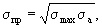
где smax - максимальное напряжение в теле штанги за цикл нагружения;
sа - амплитудное напряжение, равное (smax - smin)/2 (smin - минимальное напряжение в теле штанги за цикл нагружения).
Источник: ГОСТ Р 51161-2002: Штанги насосные, устьевые штоки и муфты к ним. Технические условия оригинал документа
3.2 предел прочности при сжатии (compressive strength) sт: Отношение максимального значения сжимающей силы Fmк первоначальной площади поперечного сечения образца, когда относительная деформация e образца в состоянии текучести (см. рисунок 1b) или при его разрушении (см. рисунок 1а) составляет менее 10 %.
3.1 прочность при растяжении перпендикулярно к лицевым поверхностям (tensile strength perpendicular to faces) smt: Отношение максимального значения силы растяжения, действующей перпендикулярно к лицевым поверхностям образца, к площади поперечного сечения образца.
3.1 прочность при растяжении параллельно лицевым поверхностям (tensile strength parallel to faces) st: Отношение максимального значения силы, действующей при растяжении образца параллельно лицевым поверхностям, к площади поперечного сечения рабочего участка образца.
В третьей области показатель степени равен 8 - 10, а влажность отпускаемого пара более 0,2 %. В этой области процесс носит кризисный характер и действительный уровень воды в барабане приближается к пароотборным трубам.
Точка перехода из 2-й области в 3-ю называется критической и работа сепарационных устройств в этой области недопустима. Работа котла в 3-й области сильно зависит от нагрузки, при этом влажность отпускаемого пара составляет 0,2 - 1,0 % и более. Ленточные солемеры показывают резкое увеличение солесодержания пара (броски).
С паровой нагрузкой котла D связаны следующие характеристики сепарационных устройств:
массовая нагрузка зеркала испарения

осевая подъемная скорость пара
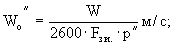
удельная паровая безразмерная нагрузка k [9[
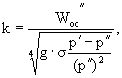
где Fз.и. - площадь зеркала испарения (или площадь пароприемного потолка).
Следующий параметр, который существенно влияет на величину влажности пара, а значит и на величину критических нагрузок, это высота активного сепарационного объема. Связь между влажностью пара, паропроизводительностью и высотой парового объема hп можно представить следующей формулой [5]
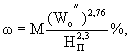 (4)
(4)где М- размерный коэффициент, определяемый физическими свойствами воды и пара.
Как видно из этой формулы, существует обратно пропорциональная зависимость между влажностью пара и высотой парового объема. Экспериментально было показано, что при увеличении высоты парового объема более 1000 мм, влажность пара уже практически мало зависит от дальнейшего ее увеличения [4] - [7].
На работу сепарационных устройств котлов существенное влияние оказывает солесодержание котловой воды (SKB). Проявляется это следующим образом. При работе котла при постоянной паропроизводительности при увеличении солесодержания котловой воды происходит очень плавное увеличение солесодержания пара, при достижении определенного значения солесодержания котловой воды происходит резкое увеличение влажности пара котла (солесодержания), регистрирующие солемеры отмечают резкое увеличение солесодержания пара (бросок). Объяснить это можно следующим образом: по мере увеличения концентрации веществ в котловой воде и прежде всего коллоидных частиц оксидов железа, шлама и др. веществ, поверхностный слой приобретает структурную вязкость. Длительность существования паровых пузырей до их разрушения увеличивается (набухание), пленки паровых пузырей успевают утониться и при разрыве их образуется большое количество мелких капель (трудно сепарируемых), вода приобретает способность к вспениванию. Значение солесодержания котловой воды, при котором происходит резкое увеличение влажности пара, называется критическим (
 ). Величина критического солесодержания зависит от давления пара в котле, конструкции сепарационных устройств, солевого состава воды («букета»), паровой нагрузки сепарационных устройств и т.д. Наиболее точно критическое солесодержание котловой воды можно определить только на основании теплохимических испытаний конкретного котла. Ориентировочно для котлов низкого давления величина критического солесодержания составляет около 3000 мг/кг, для котлов среднего давления - 1300 - 1500 мг/кг, а для котлов высокого давления - 300 - 500 мг/кг.
Одним из вариантов приспособления работы котлов на воде закритического солесодержания при умеренных значениях непрерывной продувки является применение ступенчатого испарения котловой воды. Его сущность состоит в том, что водяной объем барабана и парообразующие циркуляционные контуры разбиваются на два или три независимых отсека с подачей всей питательной воды только в 1-й отсек и отводом воды в продувку из последнего отсека. При такой схеме питания резко возрастает «внутренняя» продувка первого (чистого) отсека, которая будет равна (nп + Р) % (при выполнении котла, например по двухступенчатой схеме испарения), а увеличение продувки будет составлять в
 раза, по сравнению с котлом без ступенчатого испарения. В связи с этим концентрация солей в котловой воде 1-й ступени резко уменьшается и соответственно улучшается качество пара. Для 2-й ступени испарения концентрация солей продувочной воды будет практически такой же, как и у котла без ступенчатого испарения (при одинаковых значениях непрерывных продувок Р = const для обеих схем). Если принять, что коэффициенты выноса (или влажность пара) до и после перевода котла на ступенчатое испарение были одинаковыми, то качество пара (солесодержание) котла при переводе на ступенчатое испарение будет выше, чем у котла с одноступенчатой схемой испарения. Если же качество пара (солесодержание) котла со ступенчатым испарением принять одинаковым, как и у котла без ступеней испарения, то тогда котел со ступенчатым испарением будет работать с меньшей величиной непрерывной продувки (чем котел без ступеней испарения). В отечественном котлостроении в качестве сепараторов пара последних ступеней испарения применяют, как правило, выносные циклоны. Выносные циклоны - это устройства, которые лучше всего приспособлены для работы на воде повышенного солесодержания. (За счет развития соответствующей паровой высоты и использования центробежных сил для подавления вспенивания).
В котлах высокого давления наряду с капельным уносом имеет место значительный избирательный унос различных солей и прежде всего кремнекислоты (SiO2), за счет непосредственного физико-химического растворения солей в паре. Избирательный вынос кремнекислоты (при рН = 9,0 - 12,0) для котлов с давлением 115 кгс/см2 составляет 2,0 - 1,0 %, а для котлов с давлением 155 кгс/см2 - 4,0 - 2,5 % [9].
Для снижения кремнесодержания в паре котлов высокого давления в сепарационной схеме предусматривается паропромывочное устройство. Наличие этого устройства приводит к некоторым особенностям работы всей сепарационной схемы котлов высокого давления, по сравнению с котлами среднего давления.
В котлах высокого давления эффективность паропромывочного устройства характеризуется коэффициентом промывки
 (5)
(5)где SiO2н.п. - кремнесодержание пара на выходе из барабана;
SiO2н.п. - кремнесодержание питательной воды.
Коэффициент уноса с паропромывочного устройства Кпромопределяется по формуле
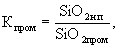 (6)
(6)где SiO2пром - кремнесодержание воды на паропромывочном устройстве.
Для котлов высокого давления по данным испытаний Кпром составляет 8 - 10 %.
Кремнесодержание промывочной воды определяется по формуле
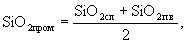 (7)
(7)где SiO2сл - кремнесодержание воды на сливе с паропромывочного устройства.
Степень очистки пара на паропромывочном устройстве определяется по формуле
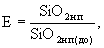 (8)
(8)где SiO2н.п.(до) - кремнесодержание насыщенного пара до паропромывочного устройства.
Кремнесодержание пара до паропромывочного устройства определяется из следующей формулы
SiO2н.п.(до) = К · SiO2к.в, (9)
где SiO2к.в. - кремнесодержание котловой воды;
К - коэффициент уноса кремниевой кислоты из котловой воды в пар до промывки.
Из приведенных формул следует, что кремнесодержание пара после промывки (пар котла SiO2н.п.) зависит как от кремнесодержания питательной воды, так и от кремнесодержания пара до промывки.
В конечном итоге чем ниже будет кремнесодержание промывочной воды (SiO2пром), тем чище будет пар котла. Концентрация кремнекислоты в промывочном слое зависит, как от качества питательной воды, так и от количества кремнекислоты, поступающей из парового объема до промывки. При неналаженной работе сепарационных устройств до промывки, наряду с избирательным уносом [формула (9)] возможен вынос значительного количества капель котловой воды, где кремнесодержание в 5 - 8 раз выше, чем в питательной воде. Попадание капель котловой воды на промывку (капельный унос) приводит к увеличению кремнесодержания промывочной воды и, как следует из формулы (6), приводит к увеличению кремнесодержания пара котла.
Качество пара котла зависит от следующих основных факторов:
Источник: СО 34.26.729: Рекомендации по наладке внутрикотловых сепарационных устройств барабанных котлов
3.1 прочность при изгибе (bending strength) sb: Максимальное напряжение, возникающее в образце под действием максимальной силы Fm, зарегистрированной при изгибе.
3.2 напряжение сжатия (compressive stress) sс: Отношение сжимающей нагрузки к первоначальной площади поперечного сечения образца данной толщины.
3.1 прочность при растяжении перпендикулярно к лицевым поверхностям (tensile strength perpendicular to faces) smt: Отношение максимального значения силы растяжения, действующей перпендикулярно к лицевым поверхностям образца, к площади поперечного сечения образца.
3.10 план статистического приемочного контроля sметода, s метод (s method acceptance sampling plan): План статистического приемочного контроля по количественному признаку, использующий известное значение стандартного отклонения процесса.
Примечание - Адаптированное определение по ИСО 3534-2.
Источник: ГОСТ Р ИСО 3951-5-2009: Статистические методы. Процедуры выборочного контроля по количественному признаку. Часть 5. Последовательные планы на основе AQL для известного стандартного отклонения оригинал документа
3.16 максимальное стандартное отклонение процесса (maximum process standard deviation); MPSD, smax: Наибольшее значение стандартного отклонения процесса для данного кода объема выборки и предельно допустимого уровня несоответствий (3.6), при котором возможно выполнение критерия приемки объединенного контроля с двумя границами поля допуска при любой жесткости контроля (нормальном, усиленном послабленном контроле), когда дисперсия процесса известна.
[ИСО 3534-2]
Примечание 1 - MPSD зависит от того, какой тип контроля применяют (объединенный, индивидуальный или сложный), но не зависит от жесткости контроля.
Примечание 2 - Адаптированное определение по ИСО 3534-2.
Источник: ГОСТ Р ИСО 3951-5-2009: Статистические методы. Процедуры выборочного контроля по количественному признаку. Часть 5. Последовательные планы на основе AQL для известного стандартного отклонения оригинал документа
3. Начальное напряжение при испытании на релаксацию si - напряжение, соответствующее начальной нагрузке образца.
Источник: ГОСТ 28334-89: Проволока и канаты стальные для армирования предварительно-напряженных железобетонных конструкций. Метод испытания на релаксацию при постоянной деформации оригинал документа
4. Остаточное напряжение после релаксации sо - действительное напряжение образца по истечении определенного промежутка времени, прошедшего с начала испытания, при условии, что общая длина образца не изменялась в течении испытания. Остаточное напряжение рассчитывается для действительной площади поперечного сечения образца, измеренного перед началом испытания.
Источник: ГОСТ 28334-89: Проволока и канаты стальные для армирования предварительно-напряженных железобетонных конструкций. Метод испытания на релаксацию при постоянной деформации оригинал документа
3.4.2 газовое отношение scg (gas fraction): Отношение энергии взрывных газов Qg к энергии взрывчатого вещества QC.
Источник: ГОСТ Р 53571-2009: Акустика. Шум, производимый на стрельбищах. Часть 2. Определение акустических характеристик дульной волны и звука пули путем расчета оригинал документа
3.4.3 акустическая эффективность sас (acoustical efficiency): Доля энергии взрывчатого вещества, превращающаяся в акустическую энергию.
Источник: ГОСТ Р 53571-2009: Акустика. Шум, производимый на стрельбищах. Часть 2. Определение акустических характеристик дульной волны и звука пули путем расчета оригинал документа
3.21 среднеквадратическое отклонение воспроизводимости результатов испытаний sR:Среднеквадратическое отклонение результатов испытаний, полученных в условиях воспроизводимости (см. 3.19) [5].
3.2 напряжение сжатия (compressive stress) sс: Отношение сжимающей нагрузки к первоначальной площади поперечного сечения образца данной толщины.
3.21 среднеквадратическое отклонение воспроизводимости результатов испытаний sR:Среднеквадратическое отклонение результатов испытаний, полученных в условиях воспроизводимости (см. 3.19) [5].
2. Пороговое напряжение при КР (sкр) - напряжение, выше которого трещины от КР возникают и растут при определенных условиях испытания.
Источник: ГОСТ 9.901.1-89: Единая система защиты от коррозии и старения. Металлы и сплавы. Общие требования к методам испытаний на коррозионное растрескивание оригинал документа
Англо-русский словарь нормативно-технической терминологии > S
-
13 switchboard
- распределительный щит
- распределительное устройство
- НКУ распределения и управления
- коммутационный щит
- коммутаторная панель
- коммутатор
коммутатор
Устройство, обеспечивающее посредством включения, отключения и переключения электрических цепей выбор требуемой выходной цепи и соединение с ней входной цепи
[Терминологический словарь по строительству на 12 языках (ВНИИИС Госстроя СССР)]Тематики
- аппарат, изделие, устройство...
EN
DE
FR
коммутаторная панель
распределительный щит
Устройство, конструктивно объединяющее несколько коммутационных элементов, предназначенных для включения, отключения и переключения электрических цепей и каналов связи в ручном режиме.
[Л.М. Невдяев. Телекоммуникационные технологии. Англо-русский толковый словарь-справочник. Под редакцией Ю.М. Горностаева. Москва, 2002]Тематики
- электросвязь, основные понятия
Синонимы
EN
коммутационный щит
—
[Я.Н.Лугинский, М.С.Фези-Жилинская, Ю.С.Кабиров. Англо-русский словарь по электротехнике и электроэнергетике, Москва, 1999 г.]Тематики
- электротехника, основные понятия
EN
низковольтное устройство распределения и управления (НКУ)
Низковольтные коммутационные аппараты и устройства управления, измерения, сигнализации, защиты, регулирования, собранные совместно, со всеми внутренними электрическими и механическими соединениями и конструктивными элементами.
[ ГОСТ Р МЭК 61439-1-2012]
низковольтное устройство распределения и управления
Комбинация низковольтных коммутационных аппаратов с устройствами управления, измерения, сигнализации, защиты, регулирования и т. п., полностью смонтированных изготовителем НКУ (под его ответственность на единой конструктивной основе) со всеми внутренними электрическими и механическими соединениями с соответствующими конструктивными элементами
Примечания
1. В настоящем стандарте сокращение НКУ используют для обозначения низковольтных комплектных устройств распределения и управления.
2. Аппараты, входящие в состав НКУ, могут быть электромеханическими или электронными.
3. По различным причинам, например по условиям транспортирования или изготовления, некоторые операции сборки могут быть выполнены на месте установки, вне предприятия-изготовителя.
[ ГОСТ Р 51321. 1-2000 ( МЭК 60439-1-92)]EN
power switchgear and controlgear assembly (PSC-assembly)
low-voltage switchgear and controlgear assembly used to distribute and control energy for all types of loads, intended for industrial, commercial and similar applications where operation by ordinary persons is not intended
[IEC 61439-2, ed. 1.0 (2009-01)]
low-voltage switchgear and controlgear assembly
combination of one or more low-voltage switching devices together with associated control, measuring, signalling, protective, regulation equipment, etc., completely assembled under the responsibility of the manufacturer with all the internal electrical and mechanical interconnections and structural parts.
[IEC 61892-3, ed. 2.0 (2007-11)]
switchgear and controlgear
a general term covering switching devices and their combination with associated control, measuring, protective and regulating equipment, also assemblies of such devices and equipment with associated interconnections, accessories, enclosures and supporting structures
[IEV number 441-11-01]
switchgear and controlgear
electric equipment intended to be connected to an electric circuit for the purpose of carrying out one or more of the following functions: protection, control, isolation, switching
NOTE – The French and English terms can be considered as equivalent in most cases. However, the French term has a broader meaning than the English term and includes for example connecting devices, plugs and socket-outlets, etc. In English, these latter devices are known as accessories.
[IEV number 826-16-03 ]
switchboard
A large single electric control panel, frame, or assembly of panels on which are mounted (either on the back or on the face, or both) switches, overcurrent and other protective devices, buses, and usually instruments; not intended for installation in a cabinet but may be completely enclosed in metal; usually is accessible from both the front and rear.
[ McGraw-Hill Dictionary of Architecture & Construction]
switchboard
One or more panels accommodating control switches, indicators, and other apparatus for operating electric circuits
[ The American Heritage Dictionary of the English Language]FR
ensemble d'appareillage de puissance (ensemble PSC)
ensemble d'appareillage à basse tension utilisé pour répartir et commander l'énergie pour tous les types de charges et prévu pour des applications industrielles, commerciales et analogues dans lesquelles l'exploitation par des personnes ordinaires n'est pas prévue
[IEC 61439-2, ed. 1.0 (2009-01)]
appareillage, m
matériel électrique destiné à être relié à un circuit électrique en vue d'assurer une ou plusieurs des fonctions suivantes: protection, commande, sectionnement, connexion
NOTE – Les termes français et anglais peuvent être considérés comme équivalents dans la plupart des cas. Toutefois, le terme français couvre un domaine plus étendu que le terme anglais, et comprend notamment les dispositifs de connexion, les prises de courant, etc. En anglais, ces derniers sont dénommés "accessories".
[IEV number 826-16-03 ]
appareillage
terme général applicable aux appareils de connexion et à leur combinaison avec des appareils de commande, de mesure, de protection et de réglage qui leur sont associés, ainsi qu'aux ensembles de tels appareils avec les connexions, les accessoires, les enveloppes et les charpentes correspondantes
[IEV number 441-11-01]
A switchboard as defined in the National Electrical Code is a large single panel, frame, or assembly of panels on which are mounted, on the face or back or both switches, overcurrent and other protective devices, buses, and, usually, instruments.
Switchboards are generally accessible from the rear as well as from the front and are not intended to be installed in cabinets.
The types of switchboards, classified by basic features of construction, are as follows:
1. Live-front vertical panels
2. Dead-front boards
3. Safety enclosed boards( metal-clad)
[American electricians’ handbook]
The switchboard plays an essential role in the availability of electric power, while meeting the needs of personal and property safety.
Its definition, design and installation are based on precise rules; there is no place for improvisation.
The IEC 61439 standard aims to better define " low-voltage switchgear and controlgear assemblies", ensuring that the specified performances are reached.
It specifies in particular:
> the responsibilities of each player, distinguishing those of the original equipment manufacturer - the organization that performed the original design and associated verification of an assembly in accordance with the standard, and of the assembly manufacturer - the organization taking responsibility for the finished assembly;
> the design and verification rules, constituting a benchmark for product certification.
All the component parts of the electrical switchboard are concerned by the IEC 61439 standard.
Equipment produced in accordance with the requirements of this switchboard standard ensures the safety and reliability of the installation.
A switchboard must comply with the requirements of standard IEC 61439-1 and 2 to guarantee the safety and reliability of the installation.
Managers of installations, fully aware of the professional and legal liabilities weighing on their company and on themselves, demand a high level of safety for the electrical installation.
What is more, the serious economic consequences of prolonged halts in production mean that the electrical switchboard must provide excellent continuity of service, whatever the operating conditions.
[Schneider Electric]НКУ играет главную роль в обеспечении электроэнергией, удовлетворяя при этом всем требованиям по безопасности людей и сохранности имущества.
Выбор конструкции, проектирование и монтаж основаны на чётких правилах, не допускающих никакой импровизации.
Требования к низковольтным комплектным устройствам распределения и управления сформулированы в стандарте МЭК 61439 (ГОСТ Р 51321. 1-2000).
В частности, он определяет:
> распределение ответственности между изготовителем НКУ - организацией, разработавшей конструкцию НКУ и проверившей его на соответствие требованиям стандарта, и сборщиком – организацией, выполнившей сборку НКУ;
> конструкцию, технические характеристики, виды и методы испытаний НКУ.
В стандарте МЭК 61439 (ГОСТ Р 51321. 1-2000) описываются все компоненты НКУ.
Оборудование, изготовленное в соответствии с требованиями этого стандарта, обеспечивает безопасность и надежность электроустановки.
Для того чтобы гарантировать безопасность эксплуатации и надежность работы электроустановки, распределительный щит должен соответствовать требованиям стандарта МЭК 61439-1 и 2.
Лица, ответственные за электроустановки, должны быть полностью осведомлены о профессиональной и юридической ответственности, возложенной на их компанию и на них лично, за обеспечение высокого уровня безопасности эксплуатации этих электроустановок.
Кроме того, поскольку длительные перерывы производства приводят к серьезным экономическим последствиям, электрический распределительный щит должен обеспечивать надежную и бесперебойную работу независимо от условий эксплуатации.
[Перевод Интент]LV switchgear assemblies are undoubtedly the components of the electric installation more subject to the direct intervention of personnel (operations, maintenance, etc.) and for this reason users demand from them higher and higher safety requirements.
The compliance of an assembly with the state of the art and therefore, presumptively, with the relevant technical Standard, cannot be based only on the fact that the components which constitute it comply with the state of the art and therefore, at least presumptively, with the relevant technical standards.
In other words, the whole assembly must be designed, built and tested in compliance with the state of the art.
Since the assemblies under consideration are low voltage equipment, their rated voltage shall not exceed 1000 Va.c. or 1500 Vd.c. As regards currents, neither upper nor lower limits are provided in the application field of this Standard.
The Standard IEC 60439-1 states the construction, safety and maintenance requirements for low voltage switchgear and controlgear assemblies, without dealing with the functional aspects which remain a competence of the designer of the plant for which the assembly is intended.
[ABB]Низковольтные комплектные устройства (НКУ), вне всякого сомнения, являются частями электроустановок, которые наиболее подвержены непосредственному вмешательству оперативного, обслуживающего и т. п. персонала. Вот почему требования потребителей к безопасности НКУ становятся все выше и выше.
Соответствие НКУ современному положению дел и вследствие этого, гипотетически, соответствующим техническим стандартам, не может основываться только на том факте, что составляющие НКУ компоненты соответствуют современному состоянию дел и поэтому, по крайней мере, гипотетически, - соответствующим техническим стандартам
Другими словами, НКУ должно быть разработано, изготовлено и испытано в соответствии с современными требованиями.
Мы рассматриваем низковольтные комплектные устройства и это означает, что их номинальное напряжение не превышает 1000 В переменного тока или 1500 В постоянного тока. Что касается тока, то ни верхнее, ни нижнее значение стандартами, относящимися к данной области, не оговариваются
Стандарт МЭК 60439-1 устанавливает требования к конструкции, безопасности и техническому обслуживанию низковольтных комплектных устройств без учета их функций, полагая, что функции НКУ являются компетенцией проектировщиков электроустановки, частью которых эти НКУ являются.
[Перевод Интент]Тематики
- НКУ (шкафы, пульты,...)
Классификация
>>>Действия
Синонимы
Сопутствующие термины
EN
- assembly
- electrical switchboard
- low voltage controlgear and assembly
- low voltage switchboard
- low voltage switchgear and controlgear assembly
- low-voltage switchgear and controlgear assembly
- LV switchgear and controlgear assembly
- LV switchgear assembly
- panel
- power switchgear and controlgear assembly
- PSC-assembly
- switchboard
- switchgear and controlgear
- switchgear/controlgear
DE
- Schaltanlagen und/oder Schaltgeräte
FR
распределительное устройство
Распределительным устройством (РУ) называется электроустановка, служащая для приема и распределения электроэнергии и содержащая сборные и соединительные шины, коммутационные аппараты, вспомогательные устройства (компрессорные, аккумуляторные и др.), а также устройства защиты, автоматики и измерительные приборы.
[РД 34.20.185-94]
распределительное устройство
Электроустановка, предназначенная для приема и распределения электрической энергии на одном напряжении и содержащая коммутационные аппараты и соединяющие их сборные шины [секции шин], устройства управления и защиты.
Примечание. К устройствам управления относятся аппараты и связывающие их элементы обеспечивающие контроль, измерение, сигнализацию и выполнение команд.
[ ГОСТ 24291-90]
[ ГОСТ Р 53685-2009]
электрическое распределительное устройство
распределительное устройство
Устройство, предназначенное для приема и распределения электроэнергии на одном напряжении и содержащее коммутационные аппараты и соединяющие их сборные соединительные устройства.
Примечание. В состав распределительного устройства дополнительно могут входить устройства защиты и управления
[ОСТ 45.55-99]
распределительное устройство
Электроустановка, служащая для приема и распределения электроэнергии и содержащая коммутационные аппараты, сборные и соединительные шины, вспомогательные устройства (компрессорные, аккумуляторные и др.), а также устройства защиты, автоматики и измерительные приборы.
[ПОТ Р М-016-2001]
[РД 153-34.0-03.150-00]
устройство распределительное
Совокупность аппаратов и приборов для приёма и распределения электроэнергии одного напряжения, вырабатываемой электростанцией или преобразуемой подстанцией
[Терминологический словарь по строительству на 12 языках (ВНИИИС Госстроя СССР)]EN
switching substation
a substation which includes switchgear and usually busbars, but no power transformers
[IEV number 605-01-02]FR
poste de sectionnement
poste de coupure
poste comprenant des organes de manoeuvre et généralement des jeux de barres, à l'exclusion de transformateurs de puissance
[IEV number 605-01-02]В качестве РУ 6—10 кВ используется сборка высокого напряжения с однополюсными разъединителями и вертикальным расположением фаз одного присоединения и одна камера КСО с выключателем нагрузки и предохранителями для подключения трансформатора. Для РУ 0,4 кВ применяются сборки низкого напряжения с предохранителями и вертикальным расположением фаз одного присоединения.
На ПС применяются открытые (ОРУ), закрытые (ЗРУ) или комплектные (КРУ) распределительные устройства.
[ http://energy-ua.com/elektricheskie-p/klassifikatsiya.html]
В общем случае ПС и РУ являются составной частью электроустановок, которые различаются:
-
по назначению:
- генерирующие,
- преобразовательно-распределительные,
-
потребительские.
Генерирующие электроустановки служат для выработки электроэнергии, преобразовательно-распределительные электроустановки преобразуют электроэнергию в удобный для передачи и потребления вид, передают ее и распределяют между потребителями;
-
по роду тока:
- постоянного тока,
- переменного тока.
-
по напряжению:
- до 1000 В,
- выше 1000 В.
Шкала номинальных напряжений ограничена сравнительно небольшим числом стандартных значений, благодаря чему изготавливается небольшое число типоразмеров машин и оборудования, а электросети выполняются более экономичными. В установках трехфазного тока номинальным напряжением принято считать напряжение между фазами (междуфазовое напряжение). Согласно ГОСТ 29322—92 установлена следующая шкала номинальных напряжений:
для электросетей переменного тока частотой 50 Гц междуфазовое напряжение должно быть: 12, 24, 36, 42, 127, 220, 380 В; 3, 6, 10, 20, 35, 110, 150, 220, 330, 500, 750 и 1150 кВ;
для электросетей постоянного тока: 12, 24, 36, 48, 60, 110, 220, 440, 660, 825, 3000 В и выше.-
по способу присоединения к электросети ПС разделяются на:
- тупиковые (блочные),
- ответвительные (блочные),
- проходные (транзитные)
- узловые.
Тупиковые ПС получают питание по одной или двум тупиковым ВЛ.
Ответвительные ПС присоединяются ответвлением к одной или двум проходящим ВЛ с односторонним или двухсторонним питанием.
Проходные ПС включаются в рассечку одной или двух проходящих ВЛ с односторонним или двухсторонним питанием.
Узловые ПС кроме питающих имеют отходящие радиальные или транзитные ВЛ.-
по способу управления ПС могут быть:
- только с телесигнализацией,
- телеуправляемыми с телесигнализацией,
- с телесигнализацией и управлением с общеподстанционного пункта управления (ОПУ).
Подстанции оперативно обслуживаются постоянным дежурным персоналом на щите управления, дежурными на дому или оперативно-выездными бригадами (ОВБ). Ремонт ПС осуществляется специализированными выездными бригадами централизованного ремонта или местным персоналом подстанции.
В РУ напряжением до 1000 В провода, шины, аппараты, приборы и конструкции выбирают как по нормальным условиям работы (напряжению и току), так и по термическим и динамическим воздействиям токов коротких замыканий (КЗ) или предельно допустимой отключаемой мощности.
В РУ и ПС напряжением выше 1000 В расстояния между электрооборудованием, аппаратами, токоведущими частями, изоляторами, ограждениями и конструкциями устанавливаются так, чтобы при нормальном режиме работы электроустановки возникающие физические явления (температура нагрева, электрическая дуга, выброс газов, искрение и др.) не могли привести к повреждению оборудования и КЗ.[ http://energy-ua.com/elektricheskie-p/klassifikatsiya.html]
Several different classifications of switchgear can be made:- By the current rating.
-
By interrupting rating (maximum short circuit current that the device can safely interrupt)
- Circuit breakers can open and close on fault currents
- Load-break/Load-make switches can switch normal system load currents
- Isolators may only be operated while the circuit is dead, or the load current is very small.
-
By voltage class:
- Low voltage (less than 1,000 volts AC)
- Medium voltage (1,000–35,000 volts AC)
- High voltage (more than 35,000 volts AC)
-
By insulating medium:
-
By construction type:
- Indoor (further classified by IP (Ingress Protection) class or NEMA enclosure type)
- Outdoor
- Industrial
- Utility
- Marine
- Draw-out elements (removable without many tools)
- Fixed elements (bolted fasteners)
- Live-front
- Dead-front
- Open
- Metal-enclosed
- Metal-clad
- Metal enclosed & Metal clad
- Arc-resistant
-
By IEC degree of internal separation
- No Separation (Form 1)
- Busbars separated from functional units (Form 2a, 2b, 3a, 3b, 4a, 4b)
- Terminals for external conductors separated from busbars (Form 2b, 3b, 4a, 4b)
- Terminals for external conductors separated from functional units but not from each other (Form 3a, 3b)
- Functional units separated from each other (Form 3a, 3b, 4a, 4b)
- Terminals for external conductors separated from each other (Form 4a, 4b)
- Terminals for external conductors separate from their associated functional unit (Form 4b)
-
By interrupting device:
-
By operating method:
- Manually operated
- Motor/stored energy operated
- Solenoid operated
-
By type of current:
-
By application:
-
By purpose
- Isolating switches (disconnectors)
- Load-break switches.
- Grounding (earthing) switches
A single line-up may incorporate several different types of devices, for example, air-insulated bus, vacuum circuit breakers, and manually operated switches may all exist in the same row of cubicles.
Ratings, design, specifications and details of switchgear are set by a multitude of standards. In North America mostly IEEE and ANSI standards are used, much of the rest of the world uses IEC standards, sometimes with local national derivatives or variations.
[Robert W. Smeaton (ed) Switchgear and Control Handbook 3rd Ed., Mc Graw Hill, new York 1997]
[ http://en.wikipedia.org/wiki/High_voltage_switchgear]Тематики
- электрификация, электроснабж. железных дорог
- электроагрегаты генераторные
- электробезопасность
- электроснабжение в целом
Синонимы
EN
- distribution
- energy distribution board
- gear
- switch-gear
- switchboard
- switchgear
- switching substation
- switchyard
DE
FR
распределительный щит
Комплектное устройство, содержащее различную коммутационную аппаратуру, соединенное с одной или более отходящими электрическими цепями, питающееся от одной или более входящих цепей, вместе с зажимами для присоединения нейтральных и защитных проводников.
[ ГОСТ Р МЭК 60050-826-2009]
щит распределительный
Электротехническое устройство, объединяющее коммутационную, регулирующую и защитную аппаратуру, а также контрольно-измерительные и сигнальные приборы
[Терминологический словарь по строительству на 12 языках (ВНИИИС Госстроя СССР)]
распределительный щит
—
[А.С.Гольдберг. Англо-русский энергетический словарь. 2006 г.]EN
distribution board
assembly containing different types of switchgear and controlgear associated with one or more outgoing electric circuits fed from one or more incoming electric circuits, together with terminals for the neutral and protective conductors.
[IEV number 826-16-08]FR
tableau de répartition, m
ensemble comportant différents types d'appareillage associés à un ou plusieurs circuits électriques de départ alimentés par un ou plusieurs circuits électriques d'arrivée, ainsi que des bornes pour les conducteurs neutre et de protection.
[IEV number 826-16-08]Distribution switchboards, including the Main LV Switchboard (MLVS), are critical to the dependability of an electrical installation. They must comply with well-defined standards governing the design and construction of LV switchgear assemblies
A distribution switchboard is the point at which an incoming-power supply divides into separate circuits, each of which is controlled and protected by the fuses or switchgear of the switchboard. A distribution switchboard is divided into a number of functional units, each comprising all the electrical and mechanical elements that contribute to the fulfilment of a given function. It represents a key link in the dependability chain.
Consequently, the type of distribution switchboard must be perfectly adapted to its application. Its design and construction must comply with applicable standards and working practises.
[Schneider Electric]Распределительные щиты, включая главный распределительный щит низкого напряжения (ГРЩ), играют решающую роль в обеспечении надежности электроустановки. Они должны отвечать требованиям соответствующих стандартов, определяющих конструкцию и порядок изготовления НКУ распределения электроэнергии.
В распределительном щите выполняется прием электроэнергии и ее распределение по отдельным цепям, каждая из которых контролируется и защищается плавкими предохранителями или автоматическими выключателями.
Распределительный щит состоит из функциональных блоков, включающих в себя все электрические и механические элементы, необходимые для выполнения требуемой функции. Распределительный щит представляет собой ключевое звено в цепи обеспечения надежности.
Тип распределительного щита должен соответствовать области применения. Конструкция и изготовление распределительного щита должны удовлетворять требованиям применимых стандартов и учитывать накопленную практику применения.
[Перевод Интент]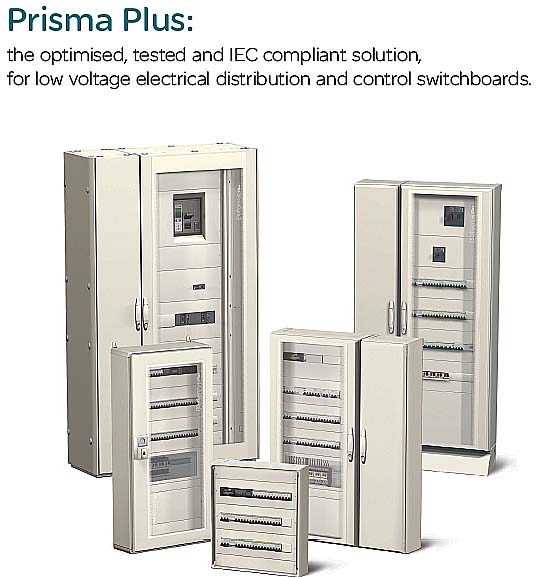
Рис. Schneider Electric
With Prisma Plus G you can be sure to build 100% Schneider Electric switchboards that are safe, optimised:
> All components (switchgear, distribution blocks, prefabricated connections, etc.) are perfectly rated and coordinated to work together;
> All switchboard configurations, even the most demanding ones, have been tested.
You can prove that your switchboard meets the current standards, at any time.
You can be sure to build a reliable electrical installation and give your customers full satisfaction in terms of dependability and safety for people and the installation.
Prisma Plus G with its discreet design, blends harmoniously into all tertiary and industrial buildings, including in entrance halls and passageways.
With Prisma Plus G you can build just the right switchboard for your customer, sized precisely to fit costs and needs.
With this complete, prefabricated and tested system, it's easy to upgrade your installation and still maintain the performance levels.
> The wall-mounted and floor-standing enclosures combine easily with switchboards already in service.
> Devices can be replaced or added at any time.
[Schneider Electric]С помощью оболочек Prisma Plus G можно создавать безопасные распределительные щиты, на 100 % состоящие из изделий Schneider Electric:
> все изделия (коммутационная аппаратура, распределительные блоки, готовые заводские соединения и т. д.) полностью совместимы механически и электрически;
> все варианты компоновки распределительных щитов, в том числе для наиболее ответственных применений, прошли испытания.В любое время вы можете доказать, что ваши распределительные щиты полностью соответствуют требованиям действующих стандартов.
Вы можете быть полностью уверены в том, что создаете надежные электроустановки, удовлетворяющие всем требованиям безопасности для людей и оборудования
Благодаря строгому дизайну, распределительные щиты Prisma Plus G гармонично сочетаются с интерьером любого общественного или промышленного здания. Они хорошо смотрятся и в вестибюле, и в коридоре.
Применяя оболочки Prisma Plus G можно создавать распределительные щиты, точно соответствующие требованиям заказчика как с точки зрения технических характеристик, так и стоимости.
С помощью данной испытанной системы, содержащей все необходимые компоненты заводского изготовления можно легко модернизировать существующую электроустановку и поддерживать её уровни производительности.> Навесные и напольные оболочки можно легко присоединить к уже эксплуатируемым распределительным щитам.
> Аппаратуру можно заменять или добавлять в любое время.
[Перевод Интент]The switchboard, central to the electrical installation.
Both the point of arrival of energy and a device for distribution to the site applications, the LV switchboard is the intelligence of the system, central to the electrical installation.
[Schneider Electric]Распределительный щит – «сердце» электроустановки.
Низковольтное комплектное устройство распределения является «сердцем» электроустановки, поскольку именно оно принимает электроэнергию из сети и распределяет её по территориально распределенным нагрузкам.
[Перевод Интент]Тематики
- НКУ (шкафы, пульты,...)
- электроснабжение в целом
EN
- branch distribution panel
- distributing board
- distributing panel
- distributing switchboard
- distribution bench
- distribution board
- distribution panel
- distribution switchboard
- gear
- keyboard
- PNL
- SB
- sw & d
- switchboard
- switchboard panel
DE
- elektrischer Verteiler, m
- Schalttafel
- Verteiler, m
FR
- tableau de distribution
- tableau de répartition, m
Англо-русский словарь нормативно-технической терминологии > switchboard
-
14 reverse
rɪˈvə:s
1. сущ.
1) а) противоположное, обратное (также с определенным артиклем) Syn: opposite, contrary б) перемена( к худшему) в) реверс, оборотная сторона, решка (о печати, монете и т. п.) ;
версо, оборотная сторона листа (книги, рукописи) Syn: back Ant: obverse г) редк. тупой конец копья Syn: butt д) мн. игра реверси
2) а) неудача, превратность to suffer, sustain a reverse ≈ терпеть неудачу serious reverse ≈ серьезная неудача slight reverse ≈ небольшая неудача tactical reverse ≈ тактический провал financial reverses ≈ финансовые просчеты meet with a reverse have reverses experience reverses б) поражение, провал ∙ Syn: disaster
3) а) прям. перен. задний или обратный ход б) тех. реверс;
задняя передача
4) воен. тыл take in the reverse
2. прил.
1) противоположный Syn: opposite, contrary
2) а) перевернутый б) обратный, оборотный, инвертированный - reverse dictionary reverse motion Syn: back, return в) тех. реверсный, задний ( о ходе, передаче)
3) воен. тыловой reverse fire
3. гл.
1) а) перевертывать, переворачивать;
опрокидывать;
ставить с ног на голову reverse arms б) тех. дать задний или обратный ход, поставить заднюю передачу, реверс в) поворачивать(ся) в противоположном направлении, разворачивать(ся)
2) а) изменять, менять;
изменять на прямо противоположное positions are reversed ≈ позиции переменились to reverse a policy ≈ круто изменить политику to reverse the order ≈ поставить в обратном порядке б) аннулировать, отменять, уничтожать (особенно о решениях, юридических документах) Syn: revoke, abrogate, undo ∙ reverse the charges обратное, противоположное (чему-л.) ;
противоположность - quite /very much/ the * нечто противоположное /обратное/ - the * of what we expected противоположное тому, что мы ожидали - we are the * of being friends мы не только не друзья, а совсем наоборот обратная сторона( медали, монеты) ;
реверс - * of a coin решка оборотная сторона листа - on the * of the cover на обороте обложки противоположная сторона( горы и т. п.) поворот в противоположную сторону (в танце) поражение, провал неудача, превратность - the *s of fortune превратности судьбы - to suffer /to meet with/ a * потерпеть неудачу - to have /to experience/ *s понести денежные потери( техническое) реверс;
реверсирование (электротехника) переполюсование, перемена полярности > in * наоборот;
роли переменились;
задним ходом;
в тылу > to take the enemy in * атаковать противника с тыла обратный;
противоположный;
перевернутый - the * side обратная сторона - in * order в обратном порядке - by the * method прямо противоположным способом противоположный, направленный в обратную сторону (о движении) - * movement движение в обратную сторону - in * gear задним ходом расположенный сзади( военное) тыльный - * battery батарея, ведущая огонь с тыла противоположным образом менять (на противоположный) ;
полностью изменять - to * the normal order изменить нормальный /обычный/ порядок на обратный;
поменять местами - to * a policy круто изменить политику - their positions are *d они поменялись ролями обращать - to * the procedure( специальное) обратить процедуру перевертывать, вывертывать;
переставлять;
опрокидывать - to * arms (военное) брать оружие в положение прикладом вверх поворачивать обратно давать обратный ход (двигателю), реверсировать давать задний ход - to * one's car into the garage задним ходом поставить автомобиль в гараж вращаться в противоположном направлении танцевать, особ. вальсировать, кружась в левую сторону (юридическое) отменять, аннулировать - to * a sentence отменить приговор - to * the decision of a lower court аннулировать решение низшей судебной инстанции (электротехника) переполюсовывать, менять полярность > to * one's field направиться в обратную сторону;
повернуть назад;
(военное) изменить направление наступления ~ неудача, превратность;
to meet with a reverse потерпеть неудачу;
to have (или to experience) reverses понести денежные потери ~ задний или обратный ход;
in reverse, on the reverse задним ходом ~ неудача, превратность;
to meet with a reverse потерпеть неудачу;
to have (или to experience) reverses понести денежные потери ~ задний или обратный ход;
in reverse, on the reverse задним ходом ~ менять, изменять;
positions are reversed позиции переменились;
to reverse a policy круто изменить политику ~ (the ~) противоположное, обратное;
quite the reverse, very much the reverse совсем наоборот reverse аннулировать, отменять ~ аннулировать ~ вносить изменения ~ тех. дать задний или обратный ход (машине) ;
реверсировать ~ задний или обратный ход;
in reverse, on the reverse задним ходом ~ кассировать ~ менять, изменять;
positions are reversed позиции переменились;
to reverse a policy круто изменить политику ~ направленный в обратную сторону ~ неудача, превратность;
to meet with a reverse потерпеть неудачу;
to have (или to experience) reverses понести денежные потери ~ неудача ~ оборотный ~ обратная сторона (монеты и т. п.) ~ обратный;
перевернутый;
противоположный;
reverse side обратная сторона;
reverse motion движение в обратную сторону;
reverse fire воен. тыльный огонь ~ обратный ~ обращать ~ отменять (судебное решение, закон) ~ отменять ~ перевертывать ~ перевертывать;
вывертывать;
опрокидывать;
to reverse arms воен. повернуть винтовку прикладом вверх ~ переделывать ~ перемена (к худшему) ~ поворачивать(ся) в противоположном направлении ~ полностью изменять ~ поражение, провал ~ поражение ~ провал ~ (the ~) противоположное, обратное;
quite the reverse, very much the reverse совсем наоборот ~ противоположный ~ тех. реверсирование;
механизм перемены хода;
to take in the reverse воен. или открыть огонь с тыла ~ резко менять направление ~ менять, изменять;
positions are reversed позиции переменились;
to reverse a policy круто изменить политику ~ перевертывать;
вывертывать;
опрокидывать;
to reverse arms воен. повернуть винтовку прикладом вверх ~ обратный;
перевернутый;
противоположный;
reverse side обратная сторона;
reverse motion движение в обратную сторону;
reverse fire воен. тыльный огонь ~ обратный;
перевернутый;
противоположный;
reverse side обратная сторона;
reverse motion движение в обратную сторону;
reverse fire воен. тыльный огонь ~ обратный;
перевернутый;
противоположный;
reverse side обратная сторона;
reverse motion движение в обратную сторону;
reverse fire воен. тыльный огонь side: reverse ~ обратная сторона to ~ the order поставить в обратном порядке ~ тех. реверсирование;
механизм перемены хода;
to take in the reverse воен. или открыть огонь с тыла ~ (the ~) противоположное, обратное;
quite the reverse, very much the reverse совсем наоборот -
15 activity-based costing
тж. activity based costing сокр. ABCупр., учет дифференцированная система калькулирования, учет затрат по видам деятельности (метод отнесения затрат на себестоимость, подразумевающий учет затрат по отдельным видам деятельности (производственным функциям), и отнесение этих затрат на определенный продукт или на счет конкретного клиента в зависимости от того, с какими видами деятельности связано производство данного товара или выполнение данного заказа)Syn:See:activity-based budgeting, activity cost assignment, activity-based system, activity cost driver, activity driver analysis, activity dictionary, activity level, responsibility accounting, value chain costing, cost driver, Kaplan, Robert* * *. . Словарь экономических терминов .Англо-русский экономический словарь > activity-based costing
-
16 annuity
сущ.1) фин., страх. аннуитет, финансовая [страховая\] рента (слово произошло от лат. "annus" — "год", изначально обозначало ежегодные выплаты)а) (равные платежи, регулярно, напр. ежемесячно, ежегодно и т. д., поступающие или выплачиваемые в течение определенного периода времени)to receive an annuity — получать аннуитет [аннуитетные платежи\]
an individual who is in receipt of an annuity — лицо, получающее аннуитет
annuity of $50 per month — аннуитет в размере $50 в месяц
$100-a-month annuity — аннуитет в размере $100 в месяц
$600-a-year annuity — аннуитет в размере $600 в год
annual [monthly\] annuity — годовой [месячный\] аннуитет
The annual annuity is determined by multiplying the amount contributed by the annuity rate. — Годовой аннуитет [годовой аннуитетный платеж\] определяется путем умножения внесенной суммы на аннуитетную ставку.
б) (соглашение или контракт, по которому физическое лицо — аннуитент — с помощью внесения единовременного или ряда периодических платежей приобретает право регулярно получать равные платежи в течение определенного периода или пожизненно; многие формы страхования основаны на этом принципе, в частности, пенсионное страхование)to purchase [to buy\] an annuity — покупать аннуитет
annuity purchaser, purchaser of an annuity — покупатель аннуитета
annuity purchase, purchase of an annuity — покупка аннуитета
annuity seller, seller of an annuity — продавец аннуитета
sale of an annuity, annuity sale — продажа аннуитета
to issue an annuity — выпускать аннуитетное соглашение [аннуитет\]*
to provide an annuity — предоставлять аннуитетные услуги*; обеспечивать аннуитетный доход [аннуитетные выплаты\]*
The group's principal activities are to provide variable annuities, fixed annuities, public and private sector pension plans and life insurance. — Основная деятельность группы — предоставление услуг по плавающим аннуитетам, фиксированным аннуитетам, государственным и частным пенсионным планам и страхованию жизни.
The lump sum can be reinvested to provide an annuity during the remainder of life. — Эта единовременная выплата может быть реинвестирована для того, чтобы обеспечить выплату аннуитетного дохода на протяжении оставшейся жизни.
to offer an annuity — предлагать аннуитет, предлагать аннуитетные услуги
This annuity pays you an income for as long as you live. — Этот аннуитет [это аннуитетное соглашение\] предусматривает выплату вам дохода в течение вашей жизни. [По этому аннуитетному соглашению вам выплачивается доход в течение вашей жизни\].
to take out an annuity — приобрести аннуитет [аннуитетный договор\]
to obtain [to get\] an annuity — приобрести аннуитет
to cancel an annuity — аннулировать [отменить\] аннуитет [аннуитетный договор\]*
annuity market — рынок аннуитетов, аннуитетный рынок
See:annuity certain, annuity due, back-to-back annuity, CD-type annuity, charitable gift annuity, constant annuity, contingent annuity, decreasing annuity, deferred annuity, fixed annuity, flexible premium annuity, group annuity, guaranteed annuity, hybrid annuity, immediate annuity, impaired annuity, increasing annuity, indexed annuity, joint and survivor annuity, joint-life annuity, life annuity, ordinary annuity, pension annuity, perpetual annuity, refund annuity, reversionary annuity, single premium annuity, split annuity, tax-sheltered annuity, variable annuity, annuity broker, annuity factor, annuity issuer, annuity market, annuity method, annuity owner, annuity period, annuity provider, annuitant, annuitize, annuitization, exclusion ratio, income drawdown2) мн., фин., брит. рентные облигации (бессрочные облигации британского правительства; в настоящее время существует два выпуска с процентными ставками 2,5 % и 2,75 %)See:
* * *
annuity; Anny 1) рента: регулярно поступающие равные платежи (на срок или пожизненно); 2) соглашение или контракт (обычно со страховой компанией), по которому физическое лицо - аннуитант - приобретает право на регулярно поступающие суммы начиная с определенного времени, напр., выхода на пенсию (часто пожизненно); см. annuitant;* * ** * *ежегодная рента; ежегодный доход; ежегодное пособие; аннуитет. Регулярные выплаты, производимые страховой компанией в пользу держателей полисов в течение определенного периода времени . The dictionary definition is a contract issued by an insurance company that pays an annuitant an amount periodically for a certain time for the remainder of his life. Common usage has expanded that definition to the point where you must dig deeper to understand the meaning. Variations include a deferred annuity where you make payments into a fund over a period of years (where tax on the fund's income is deferred), an immediate annuity (the original definition) or many other plans where a series of payments, either into or out of the fund, are involved. Словарь экономических терминов .* * *инвестиции, приносящие клиенту банка через регулярные промежутки времени определенную сумму денег доход-----годовая рента, аннуитетряд последовательных платежей, выплачиваемых через равные промежутки времени, например ежегодные лизинговые платежи-----Финансы/Кредит/Валюта1. ежегодная денежная сумма определенного размера, выплачиваемая кредитору в погашение полученного от него займа, включая проценты2. регулярно получаемый доход, не требующий от получателя предпринимательской деятельности тж. Anny-----договор, предусматривающий серию регулярных платежей на определенный период -
17 CMP
1) Общая лексика: common depth point, Crisis Management Plan (SEIC)2) Авиация: customer maintenance program3) Медицина: CMP syndrome, Container Managed Persistence, MPS, chronic myofascial pain, cytidine monophosphate, myofascial pain dysfunctional syndrome, myofascial pain syndrome, МДБ, МДБ синдром, миофасциальный болевой дисфункциональный синдром4) Американизм: Common Minimum Program5) Военный термин: Civilian Marksmanship Program, Combat Mission Planning, Common Message Parser, Communications Message Processor, Corps of Military Police, civilian medical personnel, commodity master plan, configuration management plan, contract management plan, controlled materials plan, counter-military potential6) Техника: CLEM (closed-loop ex-vessel machine) maintenance pit, calcium metaphosphate, celestial mapping program, coastal management program, common midpoint, comparator, condensate makeup pump, condition monitoring program, control microprocessor, controlled materials production7) Шутливое выражение: Can't Manage Process, Cream My Panties8) Химия: Chemical Mechanical Planarization9) Строительство: План организации строительства, Construction Management Plan10) Метеорология: Competitive Medical Plan11) Юридический термин: Civil Money Penalty12) Автомобильный термин: camshaft position sensor13) Биржевой термин: Current Market Price14) Грубое выражение: Crap My Pants15) Музыка: Chamber Music Players16) Полиграфия: Cross media publishing17) Телекоммуникации: Communications Module Processor18) Сокращение: Career Management Program (since 1999), Christian Movement for Peace, Command Module Pilot, Countermeasures Precursor, Crisis Management Plan (2004), Office of the Director, Cruise Missile Project (USA), component metal parts, counter military potential19) Физика: Colt Magnetic Particle20) Электроника: Component Maintenance Project21) Вычислительная техника: Customized Media Player, cellular multiprocessing, Cooperative Marketing Partner (DEC), Chip MultiProcessing (IBM, HP, Sun), Container-Managed Persistence (beans, Java, EJB)22) Литература: Club Management Plan23) Нефть: common mid point seismic, общая глубинная точка (common midpoint)24) Геофизика: ОГТ (в русскоязычной литературе доминирует термин "общая глубинная точка (ОГТ)", поэтому словосочетания "CMP method" и "CMP section" обычно переводятся как "метод ОГТ" и "разрез ОГТ"), ОСТ, общая средняя точка, общая глубинная площадка25) Транспорт: Cargo Movement Penalty, Central Meridian Passage26) Механика: химико-механическое выравнивание поверхности или полирование (chemical mechanical planarization or polishing)27) Фирменный знак: Central Maine Power28) СМИ: Captioned Media Program29) Деловая лексика: Certified Meeting Professional30) Глоссарий компании Сахалин Энерджи: common mid-point, contract management process, (Concrete Marking Posts) бетонные маркировочные столбы31) Образование: Connected Math Project32) Полупроводники: chemo mechanical polishing33) Океанография: Coastal Management Programs34) Химическое оружие: Comprehensive Monitoring Program, calcium methyl-phosphonate35) Макаров: chemical mechanical polishing36) Расширение файла: CorelDraw Header file for PostScript printer files, CraftMan Data file, Lead CMP compression Bitmap graphics, Microsoft Word for DOS User dictionary, PKWare compression library Compressed data, Photofinish Calibration map37) Нефть и газ: common mid-point reflection profiling, Common Mid Point38) HR. Corporate Management Policy39) NYSE. CMS Energy Corporation Tracking40) Международная торговля: Common Minimum Programme, Country Marketing Plan41) Базы данных: Certificate Management Protocol -
18 cmp
1) Общая лексика: common depth point, Crisis Management Plan (SEIC)2) Авиация: customer maintenance program3) Медицина: CMP syndrome, Container Managed Persistence, MPS, chronic myofascial pain, cytidine monophosphate, myofascial pain dysfunctional syndrome, myofascial pain syndrome, МДБ, МДБ синдром, миофасциальный болевой дисфункциональный синдром4) Американизм: Common Minimum Program5) Военный термин: Civilian Marksmanship Program, Combat Mission Planning, Common Message Parser, Communications Message Processor, Corps of Military Police, civilian medical personnel, commodity master plan, configuration management plan, contract management plan, controlled materials plan, counter-military potential6) Техника: CLEM (closed-loop ex-vessel machine) maintenance pit, calcium metaphosphate, celestial mapping program, coastal management program, common midpoint, comparator, condensate makeup pump, condition monitoring program, control microprocessor, controlled materials production7) Шутливое выражение: Can't Manage Process, Cream My Panties8) Химия: Chemical Mechanical Planarization9) Строительство: План организации строительства, Construction Management Plan10) Метеорология: Competitive Medical Plan11) Юридический термин: Civil Money Penalty12) Автомобильный термин: camshaft position sensor13) Биржевой термин: Current Market Price14) Грубое выражение: Crap My Pants15) Музыка: Chamber Music Players16) Полиграфия: Cross media publishing17) Телекоммуникации: Communications Module Processor18) Сокращение: Career Management Program (since 1999), Christian Movement for Peace, Command Module Pilot, Countermeasures Precursor, Crisis Management Plan (2004), Office of the Director, Cruise Missile Project (USA), component metal parts, counter military potential19) Физика: Colt Magnetic Particle20) Электроника: Component Maintenance Project21) Вычислительная техника: Customized Media Player, cellular multiprocessing, Cooperative Marketing Partner (DEC), Chip MultiProcessing (IBM, HP, Sun), Container-Managed Persistence (beans, Java, EJB)22) Литература: Club Management Plan23) Нефть: common mid point seismic, общая глубинная точка (common midpoint)24) Геофизика: ОГТ (в русскоязычной литературе доминирует термин "общая глубинная точка (ОГТ)", поэтому словосочетания "CMP method" и "CMP section" обычно переводятся как "метод ОГТ" и "разрез ОГТ"), ОСТ, общая средняя точка, общая глубинная площадка25) Транспорт: Cargo Movement Penalty, Central Meridian Passage26) Механика: химико-механическое выравнивание поверхности или полирование (chemical mechanical planarization or polishing)27) Фирменный знак: Central Maine Power28) СМИ: Captioned Media Program29) Деловая лексика: Certified Meeting Professional30) Глоссарий компании Сахалин Энерджи: common mid-point, contract management process, (Concrete Marking Posts) бетонные маркировочные столбы31) Образование: Connected Math Project32) Полупроводники: chemo mechanical polishing33) Океанография: Coastal Management Programs34) Химическое оружие: Comprehensive Monitoring Program, calcium methyl-phosphonate35) Макаров: chemical mechanical polishing36) Расширение файла: CorelDraw Header file for PostScript printer files, CraftMan Data file, Lead CMP compression Bitmap graphics, Microsoft Word for DOS User dictionary, PKWare compression library Compressed data, Photofinish Calibration map37) Нефть и газ: common mid-point reflection profiling, Common Mid Point38) HR. Corporate Management Policy39) NYSE. CMS Energy Corporation Tracking40) Международная торговля: Common Minimum Programme, Country Marketing Plan41) Базы данных: Certificate Management Protocol -
19 ■ work on
■ work onA v. i. + avv.continuare a lavorare; darci dentro (o sotto; fam.)B v. i. + prep.1 lavorare a; elaborare: to work on a dictionary, lavorare a un dizionario; to work on the figures, elaborare le cifre2 lavorare per: He's working on finding a new method of contraception, sta lavorando per trovare un nuovo metodo contraccettivo4 agire, intervenire su (q. o qc.); influenzare; lavorarsi (fam.): I'm trying to work on the boss, sto cercando di lavorarmi il capoC v. t. + prep.operare; fare ( un disegno) su; incidere su: to work a nice pattern on a carpet, fare un bel disegno su un tappeto; to work a heart on a tree trunk, incidere un cuore su un tronco d'albero □ (econ.) to work on contract, lavorare a contratto □ to work on one's own, lavorare da solo; (econ.) lavorare in proprio □ (fam.) I'm still working on it, mi sto ancora dando da fare. -
20 up-to-date
attributive adjective* * *1) (completed etc with the most recent information: an up-to-date dictionary; an up-to-date map; up-to-date news.)2) (modern, fashionable: up-to-date methods; up-to-date clothes.)•- academic.ru/115512/bring_up-to-date">bring up-to-date* * *\up-to-date nature of data, prices Aktualität f* * *['ʌptə'deɪt]1. adj attr up to date2. adj predauf dem neusten Stand; fashion also, book, news, information aktuell; person, method, technique also up to date pred (inf)to keep up-to-date with the fashions/news — mit der Mode/den Nachrichten auf dem Laufenden bleiben
to keep sb/sth/oneself up to date — jdn/etw/sich auf dem Laufenden halten
would you bring me up to date on developments? — würden Sie mich über den neusten Stand der Dinge informieren?
* * *up-to-date adj1. a) modern, neuzeitlichb) zeitnah, aktuell (Thema etc)2. a) auf der Höhe (der Zeit), auf dem Laufenden, auf dem neuesten Standb) modisch* * *attributive adjective* * *adj.auf dem Laufenden ausdr.auf dem neuesten Stand ausdr.modern adj.
- 1
- 2
См. также в других словарях:
Dictionary — For other uses, see Dictionary (disambiguation). For Wikimedia s dictionary project visit Wiktionary, or see the Wiktionary article. A multi volume Latin dictionary by Egidio Forcellini. A dic … Wikipedia
dictionary — /dik sheuh ner ee/, n., pl. dictionaries. 1. a book containing a selection of the words of a language, usually arranged alphabetically, giving information about their meanings, pronunciations, etymologies, inflected forms, etc., expressed in… … Universalium
Method (patent) — In United States patent law, a method, also called process , is one of the four principal categories of things that may be patented. The other three are a machine, an article of manufacture (also termed a manufacture), and a composition of matter … Wikipedia
Dictionary-based machine translation — Machine translation can use a method based on dictionary entries, which means that the words will be translated as a dictionary does – word by word, usually without much correlation of meaning between them. Dictionary lookups may be done with or… … Wikipedia
method in his madness — If there s method in someone s madness, they do things in a strange and unorthodox way, but manage to get results. (Dorking School Dictionary) … English Idioms & idiomatic expressions
method of payment — The way a merger or acquisition is financed. Bloomberg Financial Dictionary … Financial and business terms
adjusted balance method — Method of calculating finance charges that uses the account balance remaining after adjusting for all transactions posted during the given billing period as its basis. Related: average daily balance method, previous balance method, past due… … Financial and business terms
linking method — Method for calculating rates of return ( rate of return) that multiplies one plus the interim rate of return. Bloomberg Financial Dictionary … Financial and business terms
previous balance method — Method of calculating finance charges based on the account balance at the end of the previous month. Bloomberg Financial Dictionary … Financial and business terms
Comparative method — This article is about the comparative method in linguistics. For other kinds of comparative methods, see Comparative (disambiguation). Linguistic map representing a Tree model of the Romance languages based on the comparative method. Here the… … Wikipedia
Four corner method — The Four Corner Method (literal translation) (zh tsp|t=四角號碼檢字法|s=四角号码检字法|p=sì jiǎo hào mǎ jiǎn zì fǎ) is a character input method used for encoding Chinese characters either into a computer, or a manual typewriter, using four numerical digits per … Wikipedia
